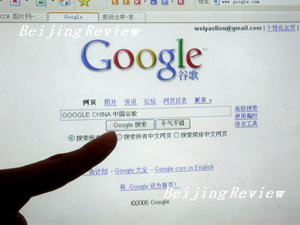
You have to hand it to Google; it knows how to make a big splash. When the doyen of search engines came to town to reinvent itself, no expense was spared. Booking the banquet hall of Beijing’s most famous five-star hotel, cramming it full of the cream of the IT world and a gaggle of journalists from 170 news agencies, there was a buzz in the air about an important announcement on April 12.
It came when Google CEO Eric Schmidt pieced together a jigsaw puzzle to reveal the name of the Internet search leader’s new Chinese venture--Gu Ge.
The Chinese rebranding of Google’s services means “harvest song” and is intended to convey “the sense of a fruitful and productive search experience, in a poetic Chinese way.” Whether it does that or not, Google is also intent on using China to establish a research center in Beijing, which expects to hire up to 150 Chinese engineers by the middle of this year and become Google’s biggest technical center outside the United States.
It’s the first time Google has opted for a foreign name, a move designed to woo the more than 111 million Chinese Internet users, a netizen legion second only to that of the United States.
Speaking to the media after the launching ceremony, Schmidt said that China accounts for only a small portion of Google’s revenue because the company has just recently obtained a license to allow it to carry local advertising. But he indicated that Google expects China to be an important part of its future business.
“I don’t know where [Chinese] revenue growth will be, but it will obviously be large,” he told Reuters.
Google has been operating under a hail of fire since the much-publicized U.S. House of Representatives hearing in February, when lawmakers attacked Google, Yahoo, Cisco Systems and Microsoft for assisting the Chinese Government by censoring Internet content. In the process the company saw its stock fall.
Taking a barrage of questions from foreign media about Google’s decision to rid its search results of any websites disapproved of by the Chinese Government, Schmidt explained that Google had a responsibility to abide by the laws of all the countries where it operates.
“It is important to operate Google’s worldwide services based on local statutes and local customs. It is not an option for us to broadly make information available that is illegal or inappropriate or immoral.”
Battling locally
Despite its number one status as a search engine worldwide, Google does not hold that position in China.
Two surveys released within a two-week period tell an interesting tale. American consultancy firm ComScore Networks reported in January 2006 that Google owned almost 40 percent of all searches in the United States in November 2005, a commanding lead of more than 10 percentage points over Yahoo, which came in second. On the other side of the Pacific a survey by the Internet Society of China, released in December last year, found 34.6 percent of Chinese Internet users chose a homegrown search engine called Baidu as their first choice, almost 10 percentage points higher than those preferring Google. Only 12 months previously, however, the organization found that Google was the absolute market leader in China, with 50.4 percent of local surfers clicking their way into its search box.
| .jpg)