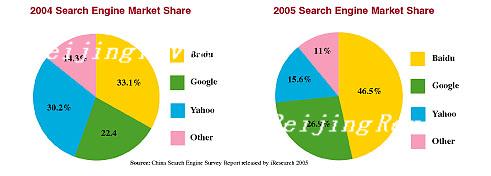
When it comes to why people go online in China, it’s a tossup between news browsing and using search engines for most netizens. Almost 70 percent and 66 percent, respectively, according to statistics from the 17th China Internet Development Statistic Report released in January this year.
In 2005, almost 98 million, making up 87.4 percent of the Internet population on the Chinese mainland, typed requests into search engines, an increase of 7.4 percent over 2004.
This number is expected to arrive at 119 million in 2006, according to the China Online Search Annual Report 2005 by iResearch, China’s leading Internet market research company. The report said search engine operators in China realized an income totaling 1.04 billion yuan in 2005, up 81.9 percent over the previous year. It’s a big business--and today the search engine service worldwide is considered to be the fourth biggest Internet profit generator after online advertising, online games and wireless value-added services.
Thriving online
Sohu.com Inc. was the first Chinese Internet search engine operator back in February 1998, the same year Google launched in the United States. But it was only at the end of 1999, when Li Yanhong and his friend Xu Yong founded powerhouse Baidu.com Inc., that the Chinese search market took off. Google and Yahoo have both since launched Chinese-language search services to extend their own reach into this gigantic market. Other major Chinese search engines now available include www.zhongsou.com (leisure search) and www.sogou.com (third generation). Chinese Internet portals like Sina and Netease also provide searching facilities.
Though it seems that Chinese Internet users are spoiled for choice, fingers are flying to leading search portals--Baidu, Google and Yahoo--in the majority of searches. Baidu ruled the roost in relation to market share in 2004 and 2005 over arch rivals Google and Yahoo (see table), and the combined dominance of these three companies extended to almost 90 percent of the entire market. In 2005, Baidu had its stock listed on the Nasdaq.
“Baidu’s comprehensive utilization, especially its multiple entertainment search, has attracted a large number of young netizens; Google enjoys advanced search techniques and an advantage on English language content searching, but it doesn’t do well in localizing its services; as for Yahoo, its music search is recognized by the market, but its Web searching still needs to be improved,” said Yang Weiqing, General Manager of iResearch.
Grabbing the youth
Of the Baidu users, 61 percent are under the age of 24 and 87.4 percent are under the age of 30, according to iResearch. It makes perfect business sense to capture this market, as the youth constitute the majority of the online community.
“Most of the time I use Baidu because it’s more convenient. I’ve tried other search engines like Sogou, but I still prefer Baidu as I’m used to it,” said Zheng Junpeng, 24, an office worker at the Beijing Topnew Import & Export Co. Ltd.
Statistics from the iResearch report show that an important reason why Baidu is preferred by the Chinese youth is that it excels at entertainment content search. In the MP3 search market, Baidu enjoys as much as 65.1 percent of the share, followed by Yahoo’s 19.7 percent and Sogou’s 5.7 percent. In the image search field, Baidu takes up as much as 52.3 percent of the total, followed by Google’s 18.6 percent and Yahoo’s 14.9 percent.
Yang predicts Baidu’s dominance in music and image search will only cement its leading status in the Chinese market.
More people search Google for websites, shopping and business information and reference material than corresponding searchers at Baidu, according to the 2005 China Online Search Market Survey Report (Beijing) by the China Internet Network Information Center.
The report also shows Google has a bigger share of high-end users, 58.7 percent, than Baidu’s 27.9 percent. In this report, high-end user refers to those who are above the age of 25, have a bachelor’s degree or above, and a monthly salary of 3,000 yuan or more. High-enders, however, are a minority, making up only 19.2 percent of the overall users.
| .jpg)