|
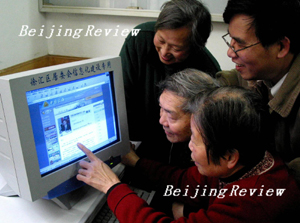
In many places in China, e-government is only used as a kind of superficial public image project, or to showcase government achievements in information technology.
Yang Fengchun, vice president of the Academy of E-Government of Peking University, said the core purpose of e-government is not the information technology itself, but rather government services. The former is only a means to support the latter.
Unsurprisingly, e-government in some parts of China is far better developed than in other areas-for example, urban compared to rural-but regardless, still faces the challenge of conflict with the current government system.
The basis of e-government is transparency of government information and affairs, and this isn’t easy to achieve.
According to Wu Jinglian, an economics professor at Peking University, e-government in Western countries, which came into being in the 1970s under reforms, intended to make government affairs more open and accountable to the public.
However, when it comes to China, the majority of government agencies are used to handling public affairs through “internal regulations,” and are reluctant to use Internet and electronic technologies in the provision of public services.
The challenge is promoting the use of information technology in government work, a situation that may start improving in the near future.
A recently completed draft document titled Regulations on Information Publication of the People’s Republic of China, states that any information, as long as it doesn’t leak “state secrets” or hurt the legitimate rights of a third party, will be made available to the public. Moreover, government information must be published on official websites.
The low rate of Internet use in China is another significant obstacle for e-government to become popular among ordinary Chinese people.
Statistics from the China Internet Information Center show that China has 120 million netizens in 2005. While this is a big number, it accounts for less than 10 percent of the county’s total population of 1.3 billion. In addition, the distribution of Internet users is determined by such factors as region, age and economic status. This has further hindered the popularization of e-government.
For example, although the convenience of online tax payment exists, many people lack access to computers or the Internet, not to mention the skills to use them, and can only turn to the old system.
“As the e-government is designed to better serve all the people, we should pay attention not only to those who are familiar with the Internet, but also to those who have difficulty in using this technology,” noted Hu Xiaoming, Deputy Director of the State Information Center.
According to Hu, given the low rate of Internet use in China, e-government services should continue to be supplemented by traditional approaches, such as telephone service, for the foreseeable future.
| .jpg)