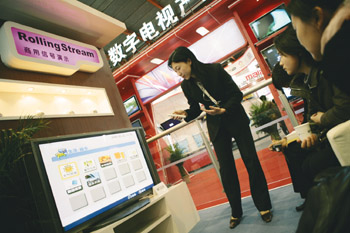
At the 14th China Cable Broadcasting Network (CCBN 2006) exhibition held in Beijing from March 21 to 23, UT Starcom’s booth, with a conspicuous catchline “Rolling Stream,” was crowded by visitors with a keen ear tuned to UT Starcom’s staff and eyes fixed on the TV screens. Guided by the staff, visitors used a special remote control to pause and rewind the live broadcast. They could also select programs from the menu display. What the visitors were watching was not ordinary TV but IPTV. “Rolling Stream” is UT Starcom’s total solution for IPTV.
Shift in focus
“UT Starcom is now in a new phase of development,” Wu Ying, Chairman and CEO of UT Starcom China, told Beijing Review. “Thanks to ‘Little Smart,’ UT Starcom has enjoyed rapid growth so far. In 2005, UT Starcom’s worldwide sales revenue was about $2.9 billion. To step up to a new phase, UT Starcom will pay more attention to two aspects——IPTV and handsets.”
IPTV delivers digital television service to subscribers via Internet Protocol over a broadband connection. “To transmit TV programs based on Internet Protocol can break the bounds of fixed time and fixed channels of traditional TV programs,” said Wu Ying.
According to him, IPTV’s worldwide expansion is a matter of time. In the post-digital TV age, IPTV will dominate the market. Though it is one kind of digital TV, it has more advantages than traditional digital TV, being “time-shifted.” When you watch IPTV, you can pause, rewind and fast forward. Programs broadcast during the past 48 hours or even one to two weeks earlier can be watched at any time you want.
IPTV is widespread in Japan and has been tested in the United States. In China, it now has hundreds of thousands of users. UT Starcom’s solution has been applied in the trial run of IPTV in Harbin of Heilongjiang Province and Shanghai.
Meanwhile, UT Starcom’s handset market is also expanding. Besides “Little Smart,” it also makes GSM and CDMA handsets. The sales volume of its handsets in North America is 7-8 million each year. The company is expanding into the international market, and its sales revenue outside China totaled $2 billion last year.
IPTV initiator
TIME-SHIFTED TV: A staff member of UT Starcom is showing visitors how to select IPTV programs from the menu display
Watching TV is the favorite pastime of most Chinese. IPTV technology and its application has a huge potential market in China. “Being the initiator of IPTV and pacemaker of IPTV technology, UT Starcom is not simply an equipment supplier, but is playing an important role in promoting the process of IPTV’s development in China,” Wu said.
“Besides selling equipment, we should encourage the development of IPTV’s industrial chain and strive for a good policy environment,” said Wu. In this respect, UT Starcom has made much progress, cooperating with telecom operators and radio and TV stations to introduce IPTV, which is safe, content-wise and inexpensive.
Through the efforts of UT Starcom, radio and television stations with licensed broadcasting rights have cooperated with telecom operators such as China Telecom and China Network Communications. Combining the two can propel China into the forefront in application of IPTV technology, providing an important basis for China to become an innovative country, said Wu Ying.
IPTV’s development in China has also won government support, said Wu. The State Administration of Radio, Film and Television has facilitated UT Starcom’s trial run of IPTV in Harbin and Shanghai.
Wu believes that IPTV’s development will have big opportunities in China and will surpass its development in the United States and Japan.
|