|
Amidst growing concerns, leading financial experts in New York said that a worldwide recession stemming from a possible U.S. recession was unlikely, but the global economy could witness a slowdown due to ongoing volatility in the world's financial markets and unpredictable oil prices.
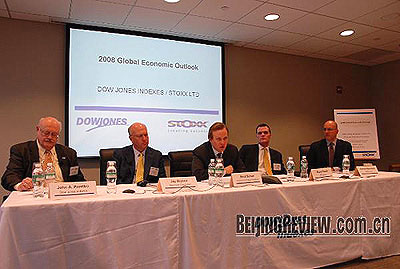
"Global growth will slow down in 2008, but a worldwide recession is unlikely," predicted Jay Bryson, a global economist at Wachovia Corp., at the sixth annual Dow Jones Indexes/ STOXX Ltd. Global Economic Outlook held in downtown New York City, on January 22.
According to Bryson, the IMF would define a global recession when global GDP growth slowed down to 2 percent. Data provided by Wachovia as of January 9 showed that global GDP would grow at 3.8 percent in 2008, and would pick up at 4.3 percent in 2009.
"This year likely will see the slowest global GDP growth since 2002," said Bryson, adding that the United States would experience weak growth, and was more likely than other developed countries to suffer from economic recession.
Risk factors
Volatility in the world's financial markets would continue and increase in 2008, said Richard Bernstein, Chief Investment Strategist at Merrill Lynch.
Brad Setser, fellow of Geoeconomics at the Council on Foreign Relations, stated that sustained high oil prices, ballooning trade deficits in Eastern Europe, dollar zone inflation, currency losses by emerging market central banks on their dollar reserves, and the lack of political support for the flow of capital from the emerging to advanced economies, were the five key risks in 2008.
Emerging markets
Developing countries, most of which are incurring a current account surplus and trading a great deal with one another, are better able to withstand a significant slowdown in the United States, said Bryson. The economic fundamentals of many developing markets had greatly improved over the past decade, he said, including their ability to deal with inflation.
China, the largest emerging market, would be influenced by the slowdown in the U.S. economy because of its trade relations with America and its ongoing connection with the U.S. dollar, said Brad Setser.
(Reporting from New York) |