|
 |
|
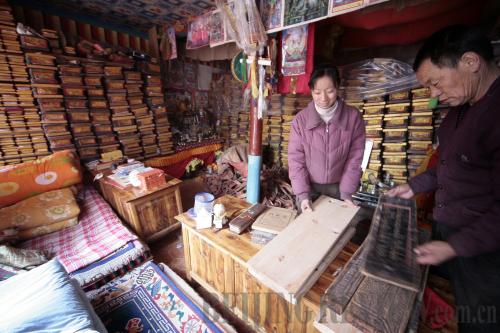
PRECIOUS: The Tibetan version of Tripitaka, a Buddhist canon of scriptures, was completely saved from the rubble of the earthquake on April 14, 2010 (CFP) |
The Gyana Mani Stone Mound in the prefecture's Yushu County, a holy place to local Tibetans and the largest of its kind in the world, was reduced to a chaotic tangle of rubble by the quake .
The site consists of a mani stone mound, two prayer halls, 490 prayer wheels and 14 pagodas. Three pagodas collapsed and cracks were visible in others.
The 1,300-year-old Temple of Princess Wencheng in Yushu County was not greatly affected in the quake, but the stone cliff behind its main hall has begun to crack, threatening the structure.
Rescue in action
Immediately following the quake, the SACH and the Provincial Government of Qinghai launched a project to rescue the damaged cultural relics.
The SACH set up an expert team four days after the quake to investigate and secure the damaged sites. Local governments took tight security measures and set up temporary protection facilities around the damaged sites.
Fortunately, the Tibetan version of Tripitaka, a Buddhist canon of scriptures, was rescued undamaged from the rubble. The rescued Tibetan Tripitaka, having been protected by a Tibetan family for more than 1,000 years, is the oldest and most complete Tibetan Tripitaka found today. It is now under special protection of the local government.
On April 20, 2010, after more than four hours of excavation, a team of soldiers from the Chinese People's Armed Police Force (CPAPF) rescued a piece of a 600-year-old tangka from the debris of the Thrangu Monastery.
Huang Zhiyuan, an officer of the CPAPF, told the PLA Daily that the soldiers recovered more than 2,000 valuable cultural relics from the damaged monastery in the six days after the quake.
Because of the delicate nature of the Buddha statues, sutra texts and tangka, the soldiers used only their hands to search for them in the debris, Huang said.
When the soldiers unearthed a Buddha statue, they used two hands to hold it and never touched the head of the statue. They dug only in the area where monks told them to, and the digging was done when monks were present.
"Every item was registered by both the temple where it was excavated and the rescue team to avoid confusion," said Huang. "We should respect the Tibetan religion and its customs, which holds tremendous respect for these relics. In fact, we were all required to wear gloves."
By April 23, 2010, a total of 1,635 Buddhist statues, 4,376 volumes of sutra texts and 120 pieces of tangka had been saved from the rubble.
After the first stage of rescue, a team of 13 experts led by Shan Jixiang, Director of the SACH, arrived at the quake zone on April 27, 2010, to help with assessment and restoration work.
On May 14, 2010, the SACH and the Qinghai Provincial Government jointly launched a rescue project, the start of the full-scale attempt of China to save cultural relics in the quake-hit area.
One week later, a plan worked out by the SACH for rescuing, protecting and renovating cultural relics in the earthquake-hit region was approved by experts. The three-year plan covers seven counties and 27 townships in Qinghai and Sichuan provinces hit by the earthquake.
|