|
 |
|
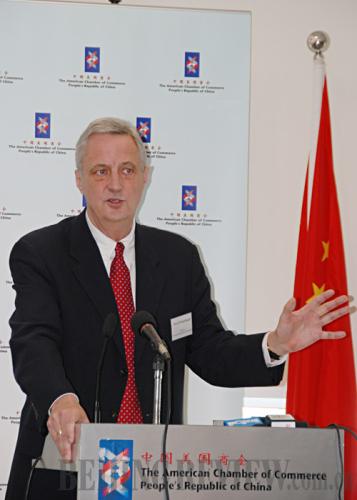
PRE-DIALOGUE PRESENTATION: Professor David Shambaugh, Nonresident Senior Fellow in the Foreign Policy Studies Program at the Brookings Institution in Washington, D.C., gives a presentation on the upcoming S&ED at the AmCham-China in Beijing on May 20 (CHEN RAN) |
The real problem with the Strategic and Economic Dialogue (S&ED) between the United States and China is there is no, or at least little, institutional follow-up on a year-round basis, a senior scholar suggested.
Professor David Shambaugh, Nonresident Senior Fellow in the Foreign Policy Studies Program at the Brookings Institution in Washington, D.C., made the remarks at the American Chamber of Commerce, People's Republic of China (AmCham-China) in Beijing on May 20.
"It needs to somehow set up implementation or continuation mechanisms for the rest of the year. It's kind of like having a roof in a house without having the pillars in the wall. We need pillars to really implement it and negotiate it," Shambaugh noted.
Shambaugh suggested that a series of established groups would work out these issues throughout the year and then make suggestions during the S&ED once a year, turning the S&ED into a kind of confirmation process.
The likely issues the United States will discuss on the Economic Track at the S&ED, according to Shambaugh, include promoting global financial stability and an open trading system, reducing barriers to U.S. exports and investment in China, gaining China's support for American initiatives in reforming the international financial system, renewing China's commitment to its WTO accession agreements, and improving transparency for the whole business operating environment in China, the yuan currency appreciation, and IPR (intellectual property rights) protection.
The relaxation of hi-tech export controls, market economy status conferred by the U.S., and assurances about the welcoming non-discriminatory environment for Chinese direct investment into the United States are possible topics on China's agenda for the event, Shambaugh noted.
There are three pillars on the Strategic Track include: counterterrorism, energy security and military-to-military relations; international and regional security issues (Iran, North Korea, Afghanistan and Pakistan); and multilateral cooperation on global issues like climate change and food security, Shambaugh quoted Deputy Secretary of State James Steinberg's keynote speech at Brookings as saying.
Shambaugh said the U.S.-China relationship has matured over the last 30 years because of the two "i"s—institutionalization and interdependence—but still lacks real strategic trust and strategic glue.
"There is no single area of common strategic glue that gives real common purpose to the strategic dimensions of the relationship. That's what I think they should be talking about on the Strategic track," he said.
More importantly, the new dimension of the U.S.-China relations is that it has become globalized, but the dialogue hasn't.
"I'm not saying that the U.S. and China should form a kind of G2—that will never happen. But we are going to continue interacting on increasing levels with each other, and start having a kind of real strategic dialogue between equals," he continued.
"That might over time produce the strategic glue that I think is needed and lacking," he added.
The establishment of the S&ED was announced on April 1, 2009 by U.S. President Barack Obama and Chinese President Hu Jintao. U.S. Secretary of State Hillary Clinton and Chinese State Councilor Dai Bingguo co-chair the Strategic Track. U.S. Secretary of the Treasury Timothy Geithner and Chinese Vice Premier Wang Qishan co-chair the Economic Track.
The first meeting was held in Washington, D.C. on July 27-28, 2009. The second round of the China-U.S. S&ED will take place in Beijing on May 24-25, 2010. |