|
 |
|
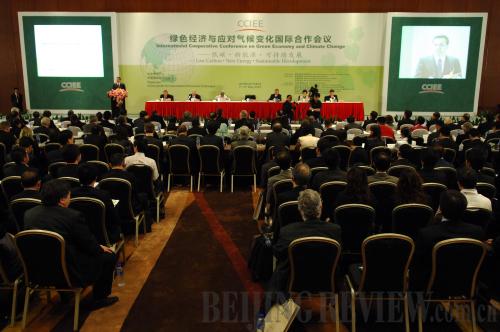
LOW-CARBON ROADMAP: About 500 participants came to the conference to exchange view and experiences on coping with climate changes with low-carbon solutions (CNSPHOTO) |
Unresolved issues at the UN Climate Change Conference 2009 in Copenhagen were revisited in Beijing on May 7-9. Officials, experts, scholars and entrepreneurs from across the world discussed bottlenecks in international cooperation to ensure a global low-carbon future.
The three-day International Cooperative Conference on the Green Economy and Climate Change was organized by the China Center for International Economic Exchanges, China's top think tank of the National Development and Reform Commission. With topics centered on low carbon, new energy and sustainable development, the conference aimed to enhance communication and understanding among nations on the world's green economic growth and green endeavor in China.
The conference consisted of six sub-forums where about 500 participants exchanged views and experiences on a wide range of topics, including ways to ensure a stronger capacity to cope with climate change and mankind's sustainable development. These include the policies and frameworks to promote international cooperation, corporate social responsibility and public participation in adapting to low-carbon production or lifestyles, technology innovation, as well as carbon finance.
While delivering a speech at the opening ceremony, Chinese Vice Premier Li Keqiang called for developed nations to assist the developing world in its green economy endeavor through technology transfers, financial assistance and market liberalization.
Officials and scholars at the sub-forum titled Low-carbon Technology Innovation and Technology Transfer also urged cheaper prices for low-carbon technology transfers. Some called for a fair and effective framework of international cooperation that allows countries to support each other in fulfilling carbon emission reduction commitments.
Priorities
The world's transition to a low-carbon economy is gathering support and is expected to catalyze a new industrial revolution. But in pursuing a low-carbon economy, priorities vary for countries at different stages of economic development.
Developing countries have different targets for carbon emission cuts and renewable energy development, because those countries are still in different stages of development, said Zhai Yongping, Principal Energy Specialist at the Southeast Asia Department of Asian Development Bank.
Climate change in the form of extreme weather such as drought and flood is just one of the many prominent challenges facing the developing world, in addition to the challenge of subsistence, such as hunger and malaria, and development, such as education and access to electricity, Zhai said.
Energy poverty is a reality in developing countries—half of the world's 1.5 billion people who have no access to electricity live in Asia.
"The 2015 targets for achieving the Millennium Development Goals are attainable largely because developing countries such as China and India have cut emissions much more than the targets they committed themselves to," Zhai said. "It's impossible for African countries located to the south of the Sahara Desert to fulfill these kinds of targets."
In China, where the economy is undergoing a growth model transformation, the top priority should be given to energy efficiency, said Du Xiangwan, Vice President of the Chinese Academy of Engineering, while elaborating on China's green energy strategies at the sub-forum.
Du advocated energy saving be viewed as a form of low-carbon energy. "China has to follow an energy-efficient development model," he said. "Otherwise, even the world's total energy output cannot meet China's demand if its per-capita energy consumption increases to the U.S. level."
In addition to energy saving, clean and efficient utilization of fossil energy, and development of renewable energies and nuclear energy are two other focuses of China's low-carbon energy strategies in the first half of this century. At the same time, innovations in smart grid and energy storage technologies have to catch up to match the development of renewable energies, Du said.
"China will face its toughest challenges in the next two decades in order to transform its coal-heavy energy utilization structure into a balanced and diversified one," he said.
|