|
It is urgent now to let air out of the property bubbles and preempt inflation as the economy seeks a smooth ride toward continued prosperity, said Yi Xianrong, a senior researcher with the Chinese Academy of Social Sciences.
In its latest move to clamp down on the property rush, the State Council on April 15 announced tough policies on second home purchases, with the down payment rate rising from 40 percent to 50 percent and mortgage rates 1.1 times the benchmark lending rate.
On the monetary front, the policymakers have relied on mild monetary adjustments to stabilize the economy. So far this year, the central bank twice raised the ratio of deposits commercial banks must put aside in reserves and has also aggressively drained cash from the banking system.
New renminbi loans in March totaled 510.7 billion yuan ($74.8 billion), a slump compared to the January and February when banks rushed out credit in anticipation of serious monetary tightening policies. The new loans totaled 1.39 trillion yuan ($203.6 billion) and 700.1 billion yuan ($102.5 billion) in January and February, respectively.
"In short, economic growth is strong. With stimulus already partly removed, the key is whether the authorities can steer the economy onto a more sustainable growth path, or whether generalized inflation and an asset bubble will break out in the latter half of 2010 and trigger a bigger policy-induced slowdown for China in 2011," said Stephen Green, an economist at Standard Chartered Bank in Shanghai.
Economic future
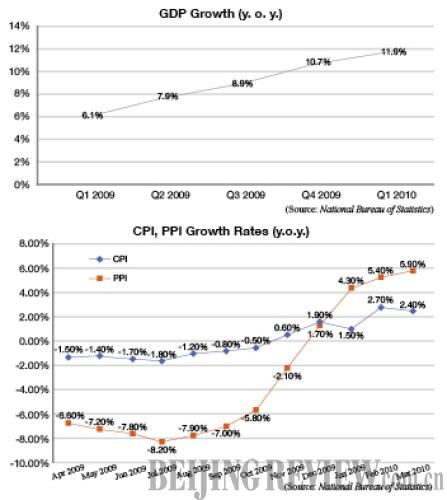
With inflation subdued and growth gathering momentum, China now has an opportunity to roll back the stimulus, said Li Daokui, Director of the Center for China in the World Economy at Tsinghua University and a newly appointed advisor to the central bank's monetary policy committee.
"The strong performance in the first quarter should remove worries over a second dip in the economy," Li Daokui said, "so the most likely time for an interest rate hike is in the second quarter this year."
Cao Heping, an economics professor of Peking University, said the effect of lending is starting to gain traction, taking some pressure off the country to act on interest rates.
Before a strong recovery is firmly in place, it will be hard to see how China can risk putting the brakes on the economy by hiking the interest rates, said Cao.
Lian Ping, chief economist at the Bank of Communications, disagreed with them. "The low inflation reading basically eliminates the possibility of drastic monetary moves in the near future," he said.
In addition, an early interest rate hike ahead of Western countries would only accelerate hot money inflows and stir domestic financing, Lian said.
International speculative capital seeking to cash in on an expected rise in the value of yuan, the Chinese currency, has also become a problem. China's foreign exchange reserve increased by $47.9 billion in the first quarter of 2010, around $10 billion more than the trade surplus in combination with foreign direct investment. The difference was widely believed to be caused by hot money that already found its way around regulatory controls and into the country. |