|
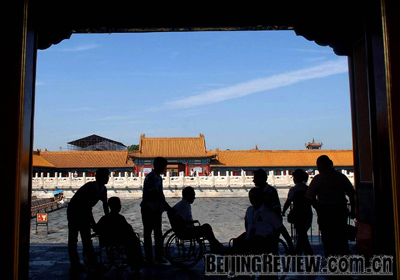
ROLLING THROUGH: Several tourists in wheelchairs visit the Forbidden City in Beijing. Parks, tourist sites and museums in the capital have improved their barrier-free facilities for the disabled
To further assist the handicapped in their social life and work, the General Office of the State Council issued a document in 2002, saying that all disabled people would be eligible for recovery service benefits by 2015. The benefits include guidance and recovery training for the deaf and psychological counseling.
The UN's Convention on the Rights of Persons with Disabilities, which came into force on May 12, prohibits all forms of discrimination at work on the basis of disabilities, including hiring, promotions and working conditions. A memorial wall dedicated to the UN convention was set up in the Peace Square at Beijing's Olympic Village in August.
Education and employment
The Chinese Government believes equality lies in education, which provides opportunities for the disabled to make a living. During the 10th Five-Year Plan period (2001-05), roughly 16,000 disabled students were admitted to institutions of higher learning. By the end of 2006, the country had granted a total of 550 million yuan ($79 million) in special education subsidies. The government's nationwide educational projects such as the Hope Project, a public service program to help children whose families are too poor to afford a complete elementary school education, and the Spring Buds Project, a program to help young female dropouts return to school, including disabled students.
Although disabled people face disadvantages in the labor market, the Constitution of the People's Republic of China now stipulates the employment rights for them. The country's Regulation on the Employment of the Disabled of 2007 provides further protection for the physically disabled and facilitates their employment rights.
The government also has created more opportunities for job training for the disabled. Duan Jianli, a partially paralyzed woman from Longyan City in Fujian Province, took a job training class seven years ago with the help of the local association for the disabled persons and later opened a flower shop. Now her business is growing steadily and she has increased its space to 38 square meters from 5 square meters, according to an article in the Guangming Daily.
Public awareness
The Paralympics made positive contributions to the cause of China's disabled population, Jia Yong, Sports Director of the China Disabled Persons' Federation, said in an interview with Xinhua News Agency.
"Changes have been made, and more are on the way," Jia was quoted as saying. "The public's mindset is changing. People have become more accepting and caring as the society develops."
The Paralympic Games also would benefit the country's disabled population by promoting social awareness, integration, and the adoption of favorable policies, Jia said.
But Tang Xiaoquan, Deputy Executive President of the BOCOG, said that more work was needed to remove the remaining impediments and social barriers for the physically disabled.
"Beijing, for example, is not yet a totally barrier-free city," Tang told Xinhua News Agency. "It takes more social progress to see more changes, both in infrastructure and in people's minds."
|
Numbers
By the end of 2007, the population of employed disabled persons had reached 4.33 million in urban China, while the number was 16.96 million in rural areas.
Nationwide welfare institutions in China have supported 92,000 orphans with disabilities. There were 269 children's homes throughout the country at the end of 2007.
Some 1.28 million disabled urban citizens are covered by the government's urban subsistence security system, a social program that grants allowances to people living in poverty according to the country's subsistence security standards. They account for 5.6 percent of the total urban population covered by the system.
Source: Guangming Daily |
|