|
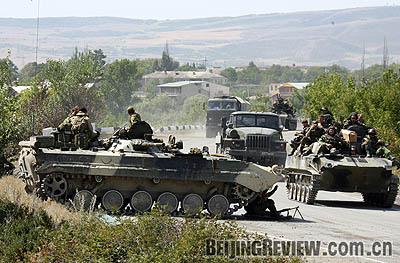
On August 8, as athletes marched into the National Stadium in Beijing to celebrate the Olympic opening ceremony, Georgian troops marched into South Ossetia and occupied Tskhinvali, the breakaway region's capital. The government offensive left thousands dead, injured or displaced, entangled Russian peacekeepers stationed in South Ossetia, and finally triggered a military conflict with neighboring Russia. The relationship among Russia, Georgia, South Ossetia and Abkhazia-another breakaway region-is so fractious because it concerns Georgia's sovereignty and Russia's strategic security. Complicating the situation are questions about regional stability, ties between superpowers and international law. Thus it will be difficult to find a solution within a short period.
Quick end to conflict
Early on August 8, a total of 100 tanks and more than 2,000 Georgian soldiers entered Tskhinvali. The next day, Russian President Dmitry Medvedev dispatched more peacekeeping troops to South Ossetia to drive out Georgian soldiers. In the meantime, Russian fighter planes targeted several military bases inside Georgia, and 9,000 soldiers and 350 armored cars arrived to defend Abkhazia. In addition, Russia's Black Sea Fleet stood against Georgian vessels.
Overwhelmed by Russian forces, on August 10, Georgian President Mikheil Saakashvili announced a troop withdrawal from South Ossetia. Two days later, French President Nicolas Sarkozy, also the current chairman of the European Union (EU), brokered a truce between Saakashvili and Medvedev. The six-point peace plan included a ceasefire, unfettered access to humanitarian aid, a return to pre-war positions by Georgian and Russian military forces, a security role for Russian peacekeepers and a commitment to international discussions on South Ossetia and Abkhazia's future security.
Medvedev declared Russia's military action a success: "The aggressor has been punished and suffered very significant losses," he said. Russia claims 74 soldiers dead, 171 wounded and 19 missing. Georgia has reported 215 military and civilian deaths, 70 soldiers missing and almost 1,500 people wounded.
Tangled disputes
Complicated and furious conflicts led to the military clash between Georgia and Russia. The two countries' goals and interests are so different that there
|