|
Yang Wei returned to training and won individual all-round titles in the 2006 and 2007 World Artistic Gymnastics Championships. Huang Xu and Li Xiaopeng chose to stay, too.
"Every day is nothing but hard training. Almost none of us had time to rest," coach Huang said when recalling the days before the Beijing Olympics. Criticisms from 17 different media organizations were hung on a wall in the gymnasium. The purpose to establish such a "wall of shame" was to remind the whole team of the crash in Athens.
Chinese gymnasts regained their dominance after two years of hard training. They overwhelmed their rivals at the 2006 World Gymnastics Championships in Aarhus, Denmark; however, their floor exercises still lacked stability, and they were also inferior to Russia and Japan in the horizontal bar. In the 2007 World Gymnastics Championships in Stuttgart, Germany, the Chinese team remarkably improved its weak points by scoring 46.175 points in the floor exercises and 47.025 points in the pommel horse. In the Beijing 2008 Olympic Games, they gained all of the leading positions in the pommel horse, rings, vaulting, parallel bars and horizontal bar.
"We've been depressed for four years by the defeat in Athens. All of the athletes and coaches are eager for the team gold in the Beijing Olympics. The victory is the reward for our painstaking efforts over the past years." Huang said.
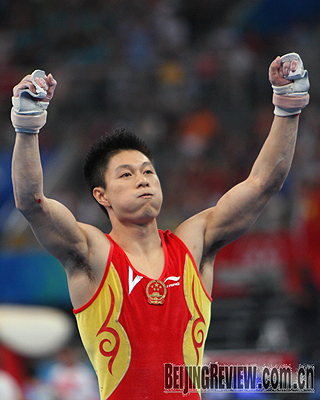
For 27-year-old Li Xiaopeng, this gold medal is more than special. It is his 15th world championship, which means, he finally overtakes Li Ning, one of China's sports icon, who lit the cauldron of the Beijing Olympic Games, to become the Chinese gymnast with the most world titles.
Although this Olympics might be the last time for triple Olympians Yang Wei, Li Xiaopeng and Huang Xu, it is a comfort for all Chinese to see upstarts Chen Yibing, Xiao Qin, Zou Kai, and other young athletes in China's
|