|
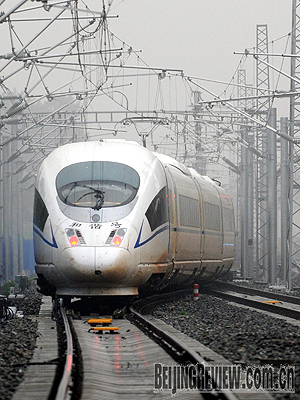
Rail commuters who travel regularly between Beijing and Tianjin will have their travel time reduced by about 40 minutes when the new high-speed Beijing-Tianjin Intercity Railway begins service in August.
The new 120-km railway, which began a trial run on July 1, will become fully operational on August 1, a week before the start of the Beijing Olympic Games. Construction of the 13-billion-yuan ($1.86 billion) project started in July 2005 and was completed at the end of last year.
The railway is the first intercity train on the mainland to reach 350 km per hour. It will shorten travel time between the two cities to about half an hour, with minimum intervals of three minutes between trains, according to the Ministry of Railways.
The eight-carriage trains will be able to transport about 60,000 people a day to five stations along the rail line: Beijing South Railway Station, Yizhuang in southeastern Beijing, Yongle and Wuqing in Tianjin's western suburbs, and Tianjin Railway Station.
The railway came about as part of Tianjin's efforts to provide faster rail transportation to meet the port city's growing logistical needs and increasing streams of intercity commuters, said Zhao Hong, a researcher at the Beijing Academy of Social Sciences, in an interview with Economic Information Daily.
It also was built as a solution to the frail transportation infrastructure between Beijing and Tianjin, which has posed a threat to the economic exuberance of the two cities, he said.
The new railway line could help alleviate the traffic congestion that plagues Beijing as well, Zhao said. It will provide a direct link to Beijing South Railway Station and subway Line 14, which, running from the southwest to the northeast, will connect outlying districts to the city center. The line is scheduled for completion in 2012.
Commuters rejoice!
Commuters who travel daily or weekly between Beijing and Tianjin will be the largest beneficiaries of the new rail line. They will enjoy much more convenient travel on the new high-speed line, as if they are traveling in one city, Zhao said.
Beijing and Tianjin currently have a combined population of around 30 million, many of whom shuttle between the two cities every week. But traffic volume on their current travel routes-via regular railway lines and the Beijing-Tianjin--Tangshan expressway--has approached maximum capacity. The expressway, built in 1993, is the first of its kind in the country. But after 15 years, it now seems worn out.
|