|
In the noon of May 14, 15 paratroopers descended from 5,000 meters above sea level into one of the hardest-hit areas of Maoxian County, a county neighboring the epicenter. They shouldered the responsibility for establishing communications, providing reconnaissance of the disaster situation and reporting to the decision-makers.
By the end of May 15, soldiers had been deployed into all 58 townships and villages most affected by the quake, sparing no effort to get to the scene quickly.
Nationwide mobilization
China's seven military area commands have all sent troops or medical forces to Sichuan to help in disaster recovery efforts.
In addition to the first 13,600 soldiers dispatched, Chengdu Military Area Command sent 16,000 more soldiers to the quake-hit areas on May 14.
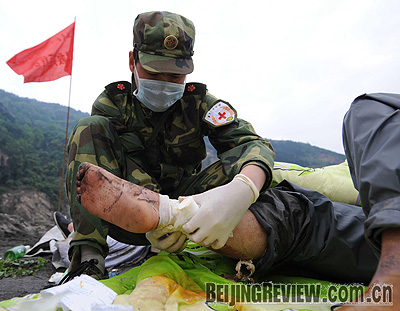
UNCOMMON HEROES: Military medical staff venture deep into the remote, quake-devastated mountains to save local residents and treat the injured
Jinan Military Area Command sent 18,000 soldiers who traveled to Sichuan by railway and motorcycle.
Lanzhou Military Area Command dispatched over 5,000 active and reserve soldiers to lend assistance.
Beijing Military Area Command organized a professional earthquake relief team of 150 soldiers. Armed with the most advanced search and rescue equipment and medical facilities, the unit is very experienced in conducting emergency rescues.
Guangzhou Military Area Command formed three medical teams of altogether 90 medical staff, and transported medical equipment and medicine worth 7 million yuan.
Nanjing Military Area Command formed six medical teams, composed of surgeons and anti-epidemic and disease prevention staff, to deliver medical equipment and medicine worth 1 million yuan ($143,000) by the end of May 14.
Li Jianhua, a high-ranking military officer at the General Logistics Department of PLA, said that by 9 a.m. on May 14, a total of 72 military medical teams made up of 2,160 staff had been dispatched to the area. Li said they transported emergency medicine and medical equipment worth over 37 million yuan ($5.3 million).
Li said that the military would further transport large medical facilities such as ambulances, anti-epidemic vehicles and surgery vehicles to the disaster area. Soon after, another 16 anti-epidemic teams will arrive on the scene.
Meanwhile, the armed police had dispatched over 20,000 soldiers to assist in the rescue work by the end of May 13 and had saved over 3,000 lives.
Zhao Picong, an officer with the Publicity Department of the Chengdu Military Area Command said that his fellow soldiers were pushing ahead with the rescue efforts "at all costs."
"Our troops didn't even assemble. We started off immediately after receiving the order," Zhao said in an interview with China Daily.
"This is no time to hesitate or feel the pressure. It's an extremely urgent situation and we're going into full gear," he added.
Zhao also said he was concerned about a lack of medical staff, poor road conditions, and damaged communications systems. But as reinforcements arrive and infrastructure is restored, rescue efforts would be able to move more efficiently, Zhao said.
The Central Military Commission has also called on the army to view rescue and relief efforts as "the most imperative and significant political task at present."
"All the troops in the relief efforts should break conventions, take exceptional measures, and race against time to get in place as soon as possible," the commission ordered.
|