|
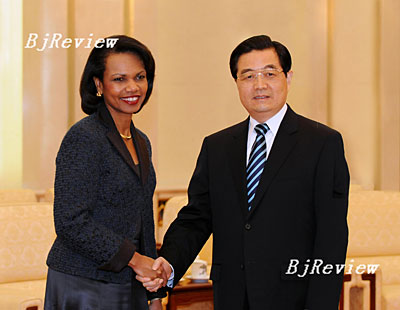
U.S. Secretary of State Condoleezza Rice reassured China about its various concerns including the sensitive Taiwan question during her recent trip to Beijing. She stopped in China for a two-day visit on February 26-27 during an East Asian tour that also took her to South Korea and Japan.
The United States adheres to the one-China policy and opposes the proposed "referendum on Taiwan's UN membership," Rice said while meeting with Chinese Foreign Minister Yang Jiechi on February 26.
The United States stands against any unilateral changes across the Taiwan Straits. It believes that the referendum, scheduled for March, will not be constructive to any side and should not be taken, she added.
While applauding the cooperation between China and the United States on political, economic and military fronts and on international issues, Rice and Chinese leaders agreed to further the two countries' "constructive and cooperative relations."
In a meeting with Rice, President Hu Jintao spoke positively about the Strategic Dialogue and Strategic Economic Dialogue mechanisms between the two nations. He also underscored the recent development of the two countries' military exchanges.
"Effective outcomes" have been achieved in China-U.S. bilateral cooperation and their coordination in global issues such as antiterrorism, trade, energy and environmental protection, he said.
Hu said 2008 would be a very important year for China and the United States. The two countries should intensify dialogues to increase mutual understanding and trust and address bilateral issues of mutual concern, he added.
Premier Wen Jiabao told Rice that China was ready to make concerted efforts with the United States to promote world economic growth and maintain the stability of world financial markets.
Wen promised that China would continue to take positive measures to address the concerns of the United States. It also hopes that the United States further opens its markets and lifts limits on hi-tech exports to China, he said.
Rice said there has been a tendency toward economic nationalism and trade protectionism in the United States, but that President George W. Bush firmly upholds free and just trade and is committed to promoting U.S.-China economic relations.
State Councilor Tang Jiaxuan emphasized the global and strategic implications of China-U.S. relations. He told Rice that China would maintain its coordination with all the other parties on the North Korean nuclear issue and jointly push forward the six-party talks aimed at resolving the issue. China also would make constructive contributions to the normalization of diplomatic ties between the countries concerned, the establishment of a peace mechanism on the Korean Peninsula and the construction of a new security structure in northeast Asia, he added.
Rice and her Chinese counterpart, Yang Jiechi, reached a consensus on resuming the China-U.S. human rights dialogue. China suspended the dialogue in 2004 when the United States decided to introduce a China-related human rights motion at the 60th session of the UN Commission on Human Rights.
Yang told Rice that China appreciates the public statements made by the U.S. Government and Rice against the Taiwan authorities' proposed referendum on the island's UN membership, as well as their repeated statements on adhering to the one-China policy, abiding by the three Sino-U.S. joint communiqués and opposing "Taiwan independence."
The United States is opposed to politicizing the Beijing Olympics, Rice said, adding that Bush and his family looked forward to attending the opening ceremony in August.
Yang and Rice also exchanged views on the Iranian nuclear issue, the Darfur issue and other international and regional issues. |