|
In 2006, ICBC and other banks launched QDII products, but QDII managers are reluctant to talk about the QDII performances. They are certain, they say, that QDII business will expand and grow rapidly once the market is entirely opened.
In September 2006, ICBC launched the first bank system QDII with an expected return rate of 7 percent in half a year. Hu Yabing, sales manager of financial market department of ICBC, said they sold 500 million yuan in two weeks. However, compared with other funds, which raised billions of yuan in a couple of days, their QDII was left in the dust.
On February 9 this year, the QDII operation had no option but to close. Hu said the return rate had surpassed the expected 7 percent if it was counted in U.S. dollars, but the QDII investors found they only reaped 2-4 percent in return.
"We had to exchange yuan into foreign currency to invest, and when the QDII was finished, we had to change foreign currency back into yuan," Hu said. "The fast appreciation of the Chinese currency ate up our yields."
After experiencing this Waterloo Bridge defeat, ICBC canceled the plan to launch other QDII product. "There are problems indeed," Hu said.
Mei Xinyu, assistant researcher with the Chinese Academy of International Trade and Economic Cooperation under the Ministry of Commerce, argued that in the short term, the QDII returns aren't very optimistic.
"At present, the return on investments in domestic market is much higher than that of the international market, and the Chinese A-share market has become the most bullish market in the world, " Mei contended, "Investors won't give up the domestic market for a far off and unfamiliar market, and if they invest in the domestic market, they can enjoy the benefit of the yuan appreciation."
Mei suggested that the QDII quota shouldn't be expanded rapidly. "We should take a step-by-step approach to increase the domestic financial institutions' ability to invest abroad, thus laying a solid foundation for the sustainable development of this area in the future."
|
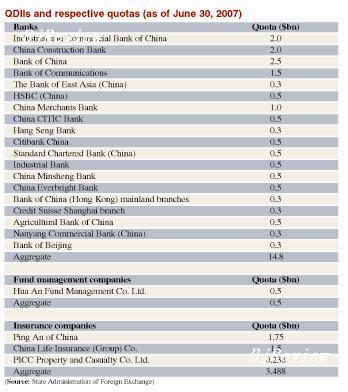
QDII ABC
What is QDII?
QDII, qualified domestic institutional investors, is a scheme relating to the capital market which is set up to give financial institutions the ability to invest in overseas markets in such categories as securities and bonds. It is a transitional arrangement that provides limited opportunity for domestic investors to access foreign markets at a stage where a country's currency is not tradable or floating completely freely and where capital is not able to move completely freely into and out of the country.
QDII development in China
China allows QDIIs to invest in foreign securities markets via approved insurance companies, banks, fund management companies and securities companies. The China Banking Regulatory Commission, China Insurance Regulatory Commission and China Securities Regulatory Commission oversee relevant QDII operators.
Concerned government departments started to research the feasibility of operating QDII schemes in 2001.
The embryo of QDII could be traced back to September 2004, when insurance companies were allowed to invest their foreign currency premiums in overseas market, including fixed-income and money-market products.
In April 2006, the People's Bank of China gave the green light for qualified banks, fund management companies and insurance companies to invest overseas, and individual investors were allowed access to the QDII scheme, but they could only invest in fixed-yield products and bonds.
In July 2006, the ICBC launched the first QDII product in the banking system. In September 2006, Hua An Fund Management Co. Ltd. initiated the first QDII (called Hua An International Balanced Fund) among fund management companies.
In May 2007, the China Banking Regulatory Commission stated that QDIIs operated by banks can invest in the stock-related products. Meanwhile, securities companies were allowed to issue QDII products. The net value of a QDII product investment in stocks must not exceed 50 percent, with the net value represented by a single stock capped at 5 percent.
|
|
.jpg)