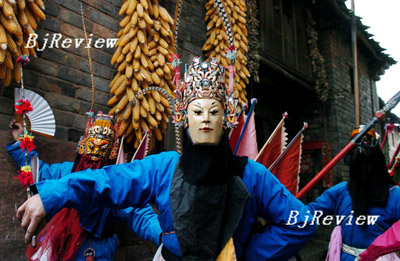
On March 22, a group of scholars from Canada and China met at Qinghai Nationalities Institute in the western Province of Qinghai to exchange ideas on how to protect the history and culture of ethnic minority groups. Speaking at the international conference, Professor Jia Yinzhong from Southwest University for Nationalities expressed worry about the inadequate protection given to the spoken and non-material cultural heritage of China's ethnic minorities.
Jia said that many of the traditions and languages of ethnic minorities are on the verge of extinction because of a lack of inheritors. In many villages, the number of people who can talk in their mother tongue has been steadily declining. In Guizhou Province in southwest China, home to around 50 ethnic groups, there used to be over 30 villages where Miao people conversed in the Miao language. Now more than a third of these villages have switched to other languages.
As one of the oldest ethnic groups in southwest China, the Gelao people have a population of 500,000, most of whom reside in two counties in Guizhou Province. The Gelao language has no writing system.
"For the time being, only a handful of elderly Gelao people understand the language," said Long Yaohong, dean of a school at Guizhou University for Nationalities. "With economic and social development, almost nobody in the two counties inhabited by Gelao people can speak the language."
In recent years, prompted by scholars, the Chinese Government has enacted and implemented a series of laws, regulations and policies on the protection of ethnic culture. In a general plan on the development of ethnic minority groups by 2010, the government has promised to collect and classify classics in ethnic languages, increase publication and news reporting in ethnic languages and preserve the customs and languages of minority groups of a very small population.
Dondrub Wangben, Vice Minister of the State Ethnic Affairs Commission, said Chinese society has attached unprecedented importance to the preservation of ethnic minority culture.
No successor
Zuochang, literally translated as sitting and singing, is an ethnic stage performance popular in northwestern Ningxia Hui Autonomous Region. As an art dating back hundreds of years, zuochang is on the verge of becoming an art form only seen in museums as there are only two professional performers, Xu Mingzhi and Zhao Jie.
"As I grow older, I have become worried about this stage art after my retirement,” said Xu. He faces enormous pressure. On the one hand, he feels one person’s strength is not enough to prevent the art form’s extinction. On the other hand, he has to create new works to satisfy his audience’s increasing demand for the ancient art.
"I started to sing on the stage at the age of 18, but who can succeed me when I cannot sing any longer?” said the 50-year-old Xu.
Xu is not the only person facing such a difficult situation. The problem of having no successors plagues most arts and crafts practiced by China’s ethnic minorities. Tan Mingrui, 78, is a celebrated singer in the Tujia language. Tan can sing the folk songs of his ethnic group for three days in a row without repetition. When asked who will learn his art, Tan answered helplessly, “What young people think of is making money. They are unable to learn my songs wholeheartedly.”
Jingzhou Miao and Dong Autonomous County is located in the southwest of the central Hunan Province. With a total population of 260,000, Jingzhou is home to 16 ethnic groups, of which Miao people and Dong people together account for over half of the total population.
In recent years, with the rapid social and economic development that China has experienced, local traditions and culture have been invaded by outside forces. Local people have scrapped the delicate traditional architecture of wooden houses built on stilts and lost interest in their traditional performing arts and rituals used to worship their ancestors.
Driven by the market economy, many young people have moved to cities to find employment where they have no opportunity to inherit their traditional culture. In cities, the majority of these young people accept a new lifestyle and gradually lose interest in traditional singing, dancing and clothing.
To make things worse, there are no professional researchers of the traditional singing and dancing of the Miao and Dong people in the region. Throughout history, both ethnic groups have passed on many of their cultural traditions visually only. Younger men and women have watched their elders perform and learned from the experience, with no written material to guide them. The younger generation’s lack of interest in learning traditional art forms means that many could die out in a generation.
"For many unique stage arts, the death of the artist will equal the death of the art. Such a scenario will cause enormous losses to China’s cultural heritage,” said Professor Wu Bing’an from Liaoning University, an expert on folk customs.
Miscommunication
Yongning Village in southwestern Yunnan Province is the home of over 1,000 Mosuo families, who are a branch of the Naxi ethnic minority group and have kept a rare matrilineal custom alive. Mosuo brides do not leave their parents to form a new family after marriage. Instead, the husband visits the wife regularly.
In recent years, Lugu Lake beside the Mosuo community has been developed as a tourism destination. Attracted by the special marriage system of the Mosuo people, some tourists hold misunderstandings about local customs.
"Many male tourists half-jokingly ask whether they can visit us as a husband regularly and other tourists ask whether we have fathers,” complained a Mosuo girl, who said these questions were insulting and irritating.
A local official said language and cultural differences had led to misunderstandings about the Mosuo people by the media, tourists and even scholars. He said many people who mistakenly believe that Mosuo people randomly have sex have come to Lugu Lake for a one-night stand, which is humiliating for Mosuo people.
Zhuo Huashan, a scholar from Hong Kong who lived in a Mosuo village for more than a year to study their society, believes that the main reason for the outside world’s misreading of the Mosuo people is the backward economy and education of the region. This lack of economic and educational development has deprived Mosuo people of the right of speech. For a long time, Mosuo culture has been interpreted by scholars and writers while the Mosuo people’s voice is rarely heard.
"Mosuo people have been studied by scholars from 20 countries, who have published their results in books. Meanwhile, the Mosuo people themselves cannot speak for themselves,” said a Mosuo scholar of the Academy of Social Sciences of Yunnan Province.
Difficult balance
Taijiang County is primarily a Miao community as about 97 percent of its 144,000 population are Miao people. Its unique culture and beautiful scenery have made the county a famous tourism spot.
In the last few years, the local government has implemented a policy encouraging farmers to earn profits from the tourism industry. Following such a policy, Jiubai Village has made a name for its traditional silver crafts. It is a tradition in the village to manufacture diaphanous silver headgear, traditional ornaments for Miao women. Gong Daxiang, 65, makes silver crafts for sale only during the idle farming season. He can make 5,000-10,000 yuan a year from his crafts, which is quite remarkable compared to his income from farming.
Some of Gong’s fellow villagers have expanded their business to other Miao tourism spots and provided tailor-made silverware for tourists and art collectors. According to the local government, these farmers can easily make 60,000 yuan per year from the silver business.
Vice Minister Dondrub believes that most ethnic minority regions suffer from backward economies but possess rich cultural resources, which can be the basis for economic growth in the tourism industry. Many ethnic minority areas in China have developed themselves into world-renowned tourism destinations, such as Lijiang in Yunnan and Jiuzhaigou in Sichuan.
However, Dondrub said considering the endangered situation of some ethnic cultures, China should make protection its top priority. He believes economic development should come only after the preservation of culture.
Despite Dondrub’s comments, some ethnic minority regions have embarked on massive property development driven by commercial interests, at the cost of the destruction of indigenous culture. Meanwhile, under the banner of protecting minority culture, some officials in ethnic minority regions have asked to confine people of a primitive ethnic minority to living in a small area.
Dondrub said every ethnic group should enjoy the rights of economic development and a better standard of living. "It is inhuman to cut off one ethnic group from the outside world only to protect its unique culture," he said. |