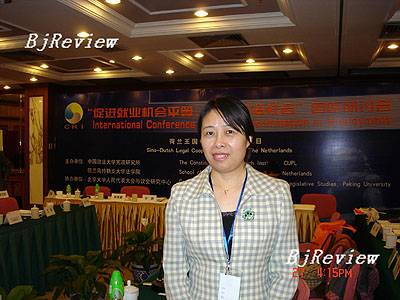
The recent cases of U.S. fast-food giants McDonald’s and KFC, accused of underpaying and exploiting part-time workers in their Chinese branches,have put labor relations under the spotlight. With deepening market-oriented economic reforms and an increasingly fast-paced integration with the global economy, the working environment in China is undergoing profound changes. In an exclusive interview with Beijing Review, Professor Lin Yanling at the China Institute of Industrial Relations discusses the current landscape of China’s labor relations, laws governing employee rights and the changing awareness of Chinese workers.
Beijing Review: How do you see the present situation regarding labor relations in China?
Lin Yanling: I feel that people today are getting more concerned with the issue of labor relations.
In detail, the current labor situation in China has taken on three features: increasing market orientation, legalization and internationalization of labor relations.
Under the planned economy, as most employers are state-owned units, disputes between employers and employees were usually solved by administrative means. But the two sides have become two independent ingredients in the labor market since the country’s market-oriented reforms in the early 1980s. Labor disputes are mounting year by year but they are now settled by means of regulations of the market mechanism.
In 1995, the Labor Law of the People’s Republic of China, the first of its kind in the country, was promulgated and entered into force. Since then China has been constructing a legal system based on the Labor Law to tackle labor disputes and regulate labor relations. In recent years China has created a grand blueprint for building a harmonious society and the protection of benefits for the under-represented groups in society has received unprecedented attention. The mass of common laborers in China are in a disadvantaged position and because of this the development of labor legislation has been put in the fast lane.
The internationalization of labor relations comes from the entry of foreign firms into China and has been enhanced since China’s entry into the World Trade Organization (WTO). Besides traditional international practices such as collective negotiation, corporate responsibility is also employed to regulate labor relations.
|