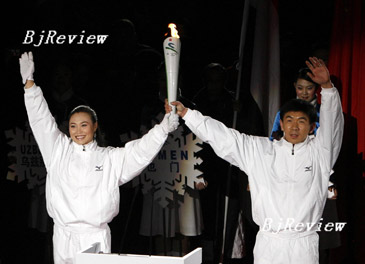
Chinese women ice hockey players proved themselves to be too much for their South Korea peers with a big win at the opening match of the sixth Asian Winter Games, which kicked off on January 28 in Changchun, Jilin Province of northeast China. It has made record numbers of athletes and participating teams with more than 1,800 participants from 45 OCA (Olympic Council for Asia) member countries and regions.
The Changchun Boarder Check Post has opened eight green channels for participants with services available in English, Russian and Japanese. Round-the-clock services will be on hand at the stadiums and gymnasiums, according to Sun Jingfeng, head of the post. He said any problem would be resolved in 10 minutes.
The last one meter
"If we consider our four-year preparation for the winter games as a 100-meter sprint, we have just a meter now to go" said An Li, Secretary-General of the Organization Committee for the Sixth Asian Winter Games. "This last meter, however, is the toughest,'' she added.
A mock inspection was held on January 18, headed by An Li. The rehearsal started from the time the athletes drove from the hotels to their destinations. The mock inspection group also carefully checked the green channels for safety as well as the foreign-language services.
An Li even tested nurses on the spot by feigning dizziness, to see their reaction speed and service. She asked them to ensure that all medicines met international standards and had instructions in foreign languages.
Having visited the Winter Games held in both Turin and Doha, An and members of the Organization Committee are quite familiar with international practice. They pointed out anything found not conforming with international standards would be fixed, including inappropriate translation.
An Li said a big sporting event needed not only high-level infrastructure facilities, but also close attention to detail.
Strong teams
China, Japan, South Korea and Kazakstan, that were ranked first four at last Winter Games winning 24, 10, 9 and 7 gold medals respectively, are sending a strong line-up for this winter games.
China has the largest numbers of delegates, including Wang Meng, Fu Tianyu and Li Ye for short track speed skating, Wang Fei for speed skating, twice world champions Shen Xue/Zhao Hongbo and 2006 world champions Pang Qing/Dong Jian for figure skating, Han Xiaopeng and Li Nina for free-style skiing, and Wang Chunli and Li Geliang, cross-country skiing.
China is tipped to win the gold in free-style skiing with such excellent athletes as Han Xiaopeng and Li Nina, said Zhao Xiaolu, Vice Chairman of the Chinese Ski Association and the head of the sports division of the Organization Committee. Han won China's first gold at the last Winter Games in Turin, and Li won two golds at the World Championship and World Cup series.
The delegation from Japan comprises 47 officials and 111 athletes, including speed skiers Zyoozi Katoo and Akemi Okazaki, and Yukari Nakano and Humie Suguri, skilled figure skaters hopeful of winning the gold medal.
Japan is expected to win 10 to 15 gold medals, said Yoshiaki Murazato, head of the delegation. Japan, as host, won 24 gold medals at the Fifth Asian Winter Games held in Aomori. He said the athletes would use the current games to prepare for the winter Olympic Games to be held in Vancouver in 2010. The country won just one gold medal at last year's winter Olympic Games.
The South Korean team with 168 members, ranks third in team numbers and will participate in all events except free-style skiing.
The Kazakhstan athletes, numbering more than 100, will participate in cross-country skiing, biathlon, short track speed skating, ice hockey speed skating and alpine skiing. They are aiming for the gold in cross-country skiing, biathlon and ice hockey. At the Doha 2006 Asian Games, they won 23 gold medals, ranking fourth in the medals tally after China, South Korea and Japan.
(Translated by LI YUZHU) |