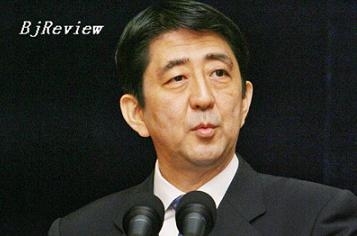
It has been a little more than four months since Shinzo Abe was sworn in as Japan's prime minister. With a flurry of diplomatic activity and policy pledges, Abe and his cabinet have largely shaped a new foreign policy framework.
Abe first adjusted the thinking behind Japan's foreign policy. To adapt to that change, he has sought an institutional reform of the government.
As soon as he assumed office on September 26, 2006, Abe raised a new diplomatic concept-"proactive diplomacy." In his policy speech to the Diet on September 29, he noted that in response to North Korea's missile launches, Japan took the initiative and proposed a draft resolution to the UN Security Council to impose sanctions on North Korea, which was adopted unanimously. "The times demanded that Japan shift to proactive diplomacy based on new thinking," he said.
Abe's proposal was consistent with Japan's quest for the status of a major political power and even a world leader. It provides further evidence that Japan, discontented with its long-held political standing since the end of World War II, is anxious to make its voice better heard in the international community.
While tightening the prime minister's grip on power at home, Abe appears poised to improve the decision-making ability of the prime minister and his cabinet on foreign affairs and security. To that end, he charged a special agency to carry out research on the establishment of a national security council. A meeting was held on January 15 to discuss the matter. Although no agreement was reached, it was decided that the prime minister, the chief cabinet secretary, the minister of foreign affairs, the minister of defense and the minister of finance would become formal members of the national security council, responsible for devising medium- and long-term security strategies.
Within this framework, security and diplomatic strategies are formulated by a small group with the prime minister at the core. It is bound to consolidate the prime minister's power in these fields. At the same time, it will weaken the influence of cabinet bureaucracies such as the Ministry Foreign of Foreign Affairs, thereby improving the efficiency of the government and helping establish a more streamlined and centralized regime that can better cope with crises.
Double axis
Over the past decades, Japan has always given top priority to the Japan-U.S. alliance in its foreign relations. Abe's cabinet is no exception. While vowing to build a "Japan-U.S. alliance for Asia and the world," the prime minister continues to cooperate closely with the United States on major international issues, such as the reconstruction of Iraq and Afghanistan. In a meeting with U.S. President George W. Bush in November last year, Abe reaffirmed the principle of strengthening the Japan-U.S. alliance based on "universal values." As far as the Japan-U.S. axis is concerned, Abe has largely inherited the policy of his predecessors without coming up with any new initiatives.
|