|
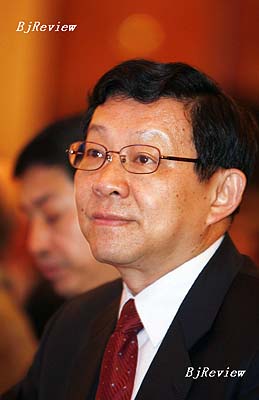
Having served in several senior government positions, Chen Deming is the new face behind the "Made-in-China" shove. The recently appointed vice minister of commerce is currently entrusted to oversee China's trade affairs, both internal and external. This came about after former Minister of Commerce Bo Xilai was appointed as Party chief of Chongqing, the country's largest municipality, in early December.
Chen made his debut as a new trade chief at China's high-profile economic dialogues with Japan and the United States, on December 1 and December 12-13, respectively. Before that, he was first vice minister of the National Development and Reform Commission (NDRC), the central-level economic planning body, in charge of energy affairs and overall economic restructuring.
However, what may better testify to Chen's competence in the area of trade is his reputation as an outstanding negotiator, which he earned during his tenure as mayor of Suzhou, one of China's fastest growing cities in coastal Jiangsu Province.
In the late 1990s, China's largest intergovernmental project, the Sino-Singapore Suzhou Industrial Park, was at risk of failure as the Singaporean Government moved to withdraw due to heavy financial losses. Chen eventually helped revive the cooperation agreement after a yearlong negotiation with Singaporean representatives. The efforts have paid off. Up to 2006, contractual foreign investment in the park had reached $26.9 billion. Local gross domestic product stood at 68 billion yuan (nearly $8.95 billion) in the year; and foreign trade volume, $50 billion.
In May 2002, Chen was transferred to less developed Shaanxi Province in northwest China, where he had successively served as vice governor and governor until he was given the NDRC post in June 2006.
As China is expected to overtake Germany as the world's second largest trader this year and there are growing disputes over the prices and quality of Chinese exports, foreign trade has become a dominant issue on the government's economic agenda. Chen's most urgent challenges will include maintaining the growth momentum of exports and foreign direct investment to China against the backdrop a global slowdown caused by the U.S. subprime loan crisis, optimizing China's export structure and further integrating domestic and foreign trade. |