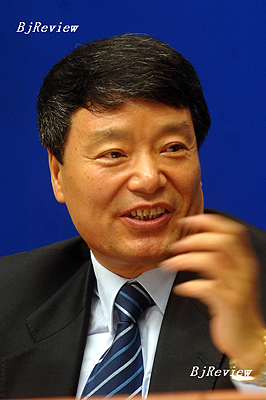
One of the most controversial issues facing Chinese society is the illegal expropriation of farmland. New head of the Ministry of Land and Resources, China's top land watchdog, Xu Shaoshi, has taken a tough stance on this issue stepping into his position in April, and very firmly put his foot down in defense of arable land area from further shrinking and being lost to the real estate mania sweeping the country.
Xu, also the state land inspector general, ordered four local governments to immediately stop illegal land use in the areas of Beijing Municipality, Henan and Yunnan provinces and Dalian City in northeast China's Liaoning Province, on July 12. "Quite a number of governmental departments of city or county level acquiesced, countenanced or even pulled the strings behind deals involving the illegal use of arable land," Xu told Xinhua, the state news agency.
Xu has acknowledged the difficulty in finding a way to protect arable land while at the same time ensuring the supply of land for accelerated urbanization and industrial development, but he is adamant a solution must be found.
According to Xu, the land approval process will be tightened to better utilize the available land. His inspection team will be strengthened to more effectively monitor land use and crack down on illegal land seizures.
A recent national survey shows that China's arable land has dwindled from 130 million hectares in 1996 to 121.8 million hectares, only slightly higher than the government-set minimum reserve requirements of 120 million hectares. The country's per-capita arable land, which stood at 0.093 hectares in 2005, is only 40 percent of the world average. This rapid loss poses a grave threat to food security and agricultural development in China.
Xu suggests that China should use its land in a more efficient way. He revealed that the area of unused construction land in the country is over 260,000 hectares at the moment, while the total area of discarded land across the country is 13 million hectares. "We can see from this that our focus must be on how to make full use of the land, rather than damaging arable areas," the minister said. |