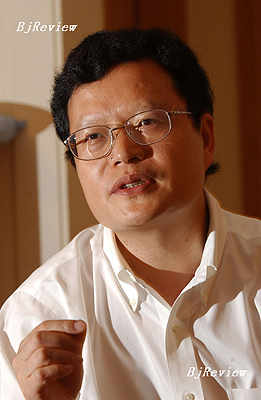
Learning institutions have the right to dismiss irresponsible and undisciplined personnel, whether they are ordinary teachers or well-known professors. But the recent ousting of Zou Hengfu, a professor of economics at China's prestigious Peking University, has put two renowned Chinese economists, Zou and his former boss, Zhang Weiying, Dean of Guanghua School of Management (business school), a faculty of the university, at each other's throats.
Zou, 45, who holds a Ph.D. in economics from Harvard University, is also a member of the Young Professional Program of the World Bank. He was invited to teach at Guanghua School in 1998, and soon named to head the applied economics department in 1999. But Zou's glory days came to an abrupt halt when he was demoted in 2005.
Since then conflicts between Zou and Zhang escalated and were dramatically exposed with the publication of their e-mail exchanges in Zou's blog.
In an e-mail from Zhang on April 6, Zou was notified that he would no longer be entitled to a professorship at Guanghua School from May 1. The reason given was his long leaves of absence from the school and his heavy involvement in other universities. Zhang said that a faculty-level meeting on April 4 had collectively decided that Zou could no longer take due responsibility for the position he held at Guanghua School.
Zou argued that he had been fired in revenge for his refusal to assist Zhang during the 2004 election campaign for dean of the faculty, in addition to his straightforward criticism of Zhang's academic views on many public occasions. Determined to get his case heard, Zou wrote to Minister of Education Zhou Ji, complaining about the injustice he had received and the bureaucracy at the university. He said he hoped the same treatment would not be given to other university professors in China. "I am talking for the dignity, right and freedom of Chinese professors," Zou said.
Zhang responded to Zou's allegations, saying that the reasons for the decision taken were self-evident and time would prove it was the right decision. Peking University's rules stipulate that professors are prohibited from holding concurrent teaching posts at other institutions, and during their tenure they are obliged to meet their quota of schooling hours and produce research results that are published in major publications.
Zou admitted that he ran academic programs at several universities, but he said he qualified for a professorship at Guanghua School for his dedication to school classes and compilation of China's first English economic and financial journal--Annals of Economics and Finance. He rebuked the allegations that professors from Guanghua School made national lecture tours for the big financial rewards involved.
"It is not in-fighting between Zhang and me. Chinese professors deserve a better academic environment, instead of being bullied by the excessive power of administrators," Zou concluded. |