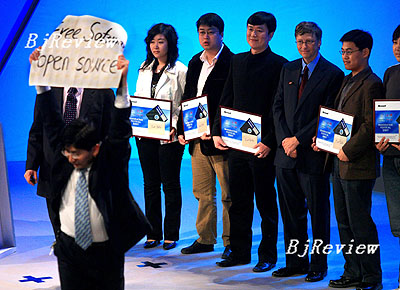
A rapid fame might not be Wang Yang really wanted, but it was his first reward after a high-profile advocate for open source software.
Wang, who also calls himself Wang Kaiyuan (literally means Wang "open source" in Chinese), interrupted a photo shoot of Microsoft Chairman Bill Gates and winners of a programming contest at an award ceremony at China's prestigious Peking University on April 20. He defiantly walked on the stage and held up a banner reading, "Free Software, Open Source."
Soon after the incident, Wang announced in his blog to quit from the post of chief representative of Linux Professional Institute (LPI) in Beijing, which he joined at the beginning of this year. LPI is a non-profit organization specializing in the certification of Linux professionals and the movement for realization of free computer software and open source programming in the IT industry.
"I am not attacking, not protesting, not even anti-monopoly, but I want to make the public aware of free software in China, " said the open source fan in an interview with Sina, one of China's major Web portal. "I will continue to promote this in schools, factories, and rural China to let more people know what open source is and help them benefit more from free software."
Previously, Wang had created an open source community for sharing of programming information and was instrumental in introducing "World Software Freedom Day" in a joint effort with Peking University and China's Open Source Software Promotion Union.
Open source computer programming works on Linux, whose programming coding is open to all users, and allows the followers of this operating system to share it for free and edit it for individual use. It is popular not only because of its benefit to common users, but also for its countermeasures to proprietary commercial software.
Open source solutions first appeared in China in the late 1990s and have since gained momentum. "It is nothing new to insiders," said Wang. "The biggest obstacle facing open source is the money-making commercial sales (of software)."
Most supporters of open source software agreed that, the open source could devise China a solution for mounting costs of commercial software and the further development of indigenous software industry.
|