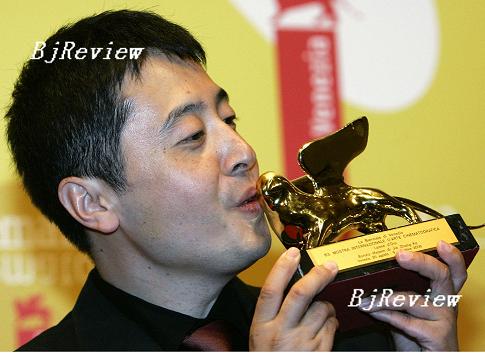
"Really, I never, never expected to win this," said Chinese director Jia Zhangke on hearing he had taken the top award for his movie Still Life (Sanxia Haoren) at the Venice Film Festival, on September 9.
A surprise late entry, Still Life quickly emerged as the favorite and the Gold Lion was again hugged by Chinese. The well-known Chinese director Zhang Yimou won the same award back in 1999, for Not One Less-also a story of rural China.
Shot in Fengjie, a poor and remote town of Chongqing Municipality, which was inundated during the building of the Three Gorges Dam, Still Life recounts the story of two separated couples in the town and how they have to continue their lives in the wave of massive relocation to make way for the project.
Boasting the world's biggest hydropower generator, the project has relocated some 1.13 million people to other parts of the country, and their adaptation to their new living environment has been a big concern of both the government and the people in China.
"This will encourage more young directors and also shows respect for the people in my film," Jia said in thanking the jury. He said he had spent almost a decade making the film." Most young Chinese directors have the desire and aspiration to tell the reality of China. Though we face difficulties, the Chinese film industry is full of creativity."
Jia, 36, made his name as a member of the emerging "sixth generation" of Chinese directors, more skilled and expressive in their technique. Led by pioneering directors Wang Xiaoshuai, Jia Zhangke and Zhang Yuan, Chinese movies are inclined to tell real life stories about ordinary Chinese and to reflect their inner struggles at the rapid changes in the country.
|