|
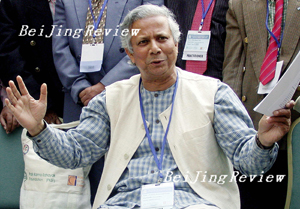
Bangladeshi economist Muhammad Yunus has been awarded this year's Nobel Peace Prize for making small loans to the poorest of the poor through his Grameen Bank. Grameen, meaning "rural" or "village" in Bangla language, is the world's first microcreditor on this scale.
By offering microcredit to the impoverished, Yunus helps those desperately struggling in poverty be more accessible to small business startup. The 66-year-old banker allows those who borrow to change their lives through self-employment, by using their loans to purchase material needed and avoiding dealing with agents or middlemen.
Yunus started his anti-poverty campaign in 1974 during a famine in Bangladesh. At the time he loaned a group of villagers $27 so as they would not be forced to resort to money lenders. The economics professor is now regarded as one of the leading developers of the microcredit system.
"No collateral is needed and the repayment is based on an honor system," said Yunus, known as the "Banker to the Poor." Grameen boasts a repayment rate as high as 99 percent. According to Yunus, the bank has loaned 29.03 billion taka ($5.72 billion) to 6.5 million Bangladeshis, 97 percent of whom were women, since the program was first launched three decades ago.
Yunus said by recognizing his efforts the Nobel committee was endorsing his dream to achieve a poverty-free world. He said he would be giving back part of the $1.4 million prize money to create a company making low-cost, high nutrition food for the poor.
The Chinese Government has also been inspired by the microcredit idea to help its 80 percent rural population's development and to alleviate the impoverished 23.6 million farmers (statistics by the end of 2005). Actually, at the early 1990s, China had already introduced the Bangladeshi model to spur its rural development, according to Du Xiaoshan, Deputy Director of Rural Development Institute of Chinese Academy of Social Sciences.
|