|
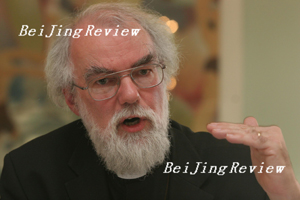
The Archbishop of Canterbury, Rowan Williams, has gained a deeper understanding of China's progress in religious freedom and its role in establishing a "harmonious society" after wrapping up his October 8-23 visit recently.
At the invitation of the Chinese Protestant Church, the spiritual head of the 77-million-member Anglican Communion made full use of his trip by holding talks with church leaders, academics and government officials, giving sermons at churches and paying visits to Christian communities and research institutions. After an absence of 12 years, his voyage this time around marked the first direct exchange between the Church of England, of which Williams is the spiritual leader, and Chinese Christianity.
During his stay in China, Williams showed major concern about China's harmony mission and was inspired to see the rising participation of the public in a wide range of social issues, from environmental protection to social welfare programs, in which churches, NGOs and other charity groups are widely involved. "There is great opportunity for Christian leaders and Christian intellectuals to play their part in these responsible discussions," he said noting China's tremendous potential.
Speaking in Nanjing, Williams said it would be important for the Chinese voice to be heard. He said China is a society which will have messages to give to the rest of the world but that he hoped Chinese society was also willing to receive and to hear what the rest of the world has to say. This would begin by experiences of "sharing a cultural distinctiveness in our different settings; it begins in developing that global awareness without which no civilization is going to last." said Williams.
The Church of England and Chinese Protestant Church reached an agreement to proceed with plans to receive Anglican theologians in China for the purposes of teaching and also to have Chinese seminarians study abroad. Williams said discussions had also taken place about the possibility of foreign help to enlarge Chinese seminary libraries and to train religious scholars.
Williams said he thought there is a remarkable amount of freedom of initiative for a number of religious groups and the Church of England was content to work with a church which "we see to be lively and active and capable of taking initiative."
|