|
 |
|
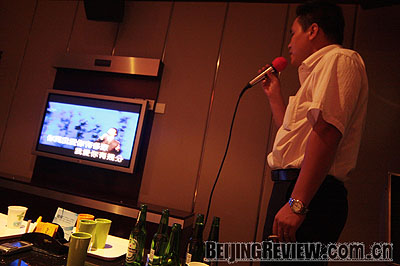
POPULAR PASTIME: A customer sings at one of Beijing's karaoke bars. Few karaoke bars in the city pay copyright royalties |
The China Audio-Video Copyright Association (CAVCA) on October 17 filed lawsuits at seven courts in Beijing against 100 Beijing-based karaoke bar operators refusing to pay royalties for songs and MTV videos. On the list were popular bars, including Tongyishouge and Huayangnianhua. This is so far the largest collective civil lawsuit covering karaoke copyrights in China.
In early August, the CAVCA publicized new karaoke charges across the country, with Shanghai topping the charge rates at 11.1 yuan ($1.6) per day for each karaoke room.
The association, which is responsible for charging karaoke bars, had sent notices to about 300 Beijing-based karaoke bars in late September, urging them to pay royalties before October 10.
In order to better encourage karaoke operators to pay copyright charges, the CAVCA gives operators who pay on their own initiative preferential treatment.
However, by the date the lawsuit was filed, only around a dozen operators out of some 1,500 in Beijing had paid royalties.
The association hoped the move would urge wavering karaoke bar operators to make payments as soon as possible, or risk being ordered to delete songs from their sound systems and pay compensation.
"Operators refusing to pay royalties will not only pay for using the products but also for their copyright infringements," said the association's Director General Wang Huapeng.
Wang said the move was just the beginning and the association will file second and third lawsuits until all karaoke operators have paid their dues. However, negotiation is still welcome on the issue, he added.
China has about 100,000 karaoke enterprises, among which 80 percent use video on demand (VOD) systems to provide music accompaniment services. VOD system providers rarely get authority from relevant copyright holders.
In order to protect the copyrights of audio-video works, on December 23, 2005, with the approval of the State Copyright Bureau, China Audio-Video Association (the predecessor of the CAVCA) began to develop.
|