|
Lao She, one of China's greatest contemporary writers, is a household name across the country. Renowned for producing novels and plays in vivid Beijing dialect, one of his most noted works was Teahouse, a play in three acts, written in 1957.
Through showcasing life in a teahouse, the play paints a picture of social life in the first half of the 20th century. There are over 70 characters of different ages in the play, which is so highly acclaimed that many people believe it represents the highest artistic level of Chinese theater. It has earned fans across different generations and in September 1980, was first staged outside China during a tour of Europe.
Lao She Teahouse, named after the noted writer, was given its current name in 1988. The teahouse, founded by 41-year-old Yin Shengxi with over 20 young people, in 1979, was formerly called Youth Teahouse. At its inception, the teahouse was in fact only a tea stand in Qianmen Avenue, home to many of Beijing's time-honored brands. It sold tea at just 0.02 yuan per cup.
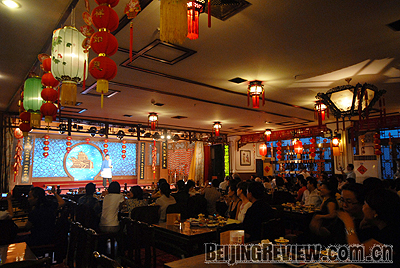
Today Lao She Teahouse has adopted the decorative style of ancient Beijing, and provides tea alongside Peking Opera, acrobatics and magic shows as well as local snacks and dishes.
The teahouse has received millions of tourists from home and abroad, including dozens of heads of state. "Our teahouse operates as normal when a state head visits it. Since they want to experience the real life of a Beijing citizen, they want more than anything to simply to sit among ordinary people and cheer and applaud with everyone else," said Yin Zhijun, General Manager of the teahouse and daughter of its founder Yin Shengxi.
Lao She Teahouse is more than an ordinary teahouse. The first floor of the three-story building is an exhibition hall for tea and tea ware and an area where people can drink tea; the tea drinking area on the second floor is decorated in the style of an ancient quadrangle courtyard, with rosewood architecture and colorful curtains; and the third floor is a restaurant, featuring royal court cuisine and Chinese tea culture.
After renovation in preparation for the upcoming Olympics that lasted nearly half a year, the teahouse was reopened in May.
Since 2004, the teahouse has held tea festivals with various themes every year. To promote the Beijing Olympic Games, in 2006 it developed a tea performance, using teas in white, blue, yellow, black, green and red, the colors of the Olympic rings. The performance won a national tea performance award in November 2006. |