|
 |
|
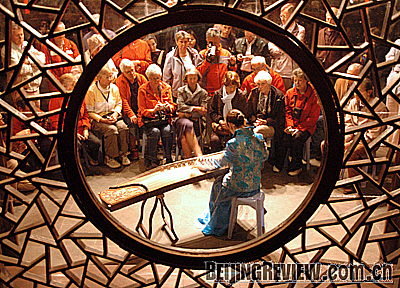
HEAVENLY SOUND: Foreign tourists listen to a musician playing Guzheng, a traditional Chinese instrument, in Wangshi Garden (Master of Nets), Suzhou |
With a history of more than 2,500 years, Suzhou, in east China's Jiangsu Province, is best known for its exquisite architecture and elegant gardens. So beautiful are the gardens in fact that they have served as ambassadors to the world on many occasions, their images adorning the background displays of cultural and commercial events hosted by the government and private enterprises.
The Ming Hall in Metropolitan Museum in New York City is a clone of a cottage from one of Suzhou's gardens; and the Dr. Sun Yat-sen Classical Chinese Garden in Vancouver is modeled on Ming Dynasty (1368-1644) gardens in Suzhou.
Two styles of garden are prevalent in China: imperial gardens, often seen in Beijing; and the private gardens found in Suzhou.
In its heyday, Suzhou had more than 280 private gardens. Some remain well preserved and are open to the public. The most famous of these are Canglangting Garden (Surging Waves Pavilion), first built in the Song Dynasty (960-1279), Shizilin Garden (Lion Forest) of the Yuan Dynasty (1279-1368), Zhuozheng Garden (Humble Administrator's) of the Ming Dynasty (1368-1644), Liu Garden (Lingering) of the Qing Dynasty (1644-1911). They are valued for their history and cultural connation, as well as for the era they represent.
The UNESCO World Heritage Committee listed some of Suzhou's classical gardens, including Zhuozheng Garden, Liuyuan Garden, Wangshi (Master of Nets) Garden and Huanxiu (Embracing Beauty) Mountain Villa as world cultural heritage sites in December 1997.
Canglangting is one of the oldest surviving classical gardens in south China. Its most prominent feature is that one can enjoy the scenery before entering the garden. Across a clear stream that meanders around the garden, visitors can see the contours of pavilions and terraces with different heights, whose images are mirrored in the rippling water. The garden is accessible through a bridge. Inside the garden, man-made hills dominate the scene. Buildings are constructed around the hills, connected by zigzagging paths lined with clusters of green bamboo and exuberant shrubs or trees. Canglangting Pavilion nestles among woods at the top of a hill.
|