|
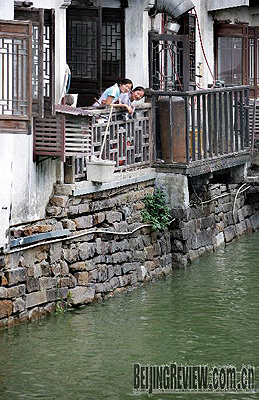
STILL WATERS: Suzhou is famous for its waterways, which crisscross the city's old town. Many of the canals recently banned cargo boats (WANG XIANG)
Famous for its waterways, Suzhou is known as "oriental water city." But besides this, what else is the city? Three residents talk about what Suzhou means to them.
Change and leisure
Cao Xiaokang, a 69-year-old retired primary school master, lives with her husband in a 75-square-meter apartment outside the old town of Suzhou. Before 1994, her family and the families of her four sisters shared a 200-square-meter house in Ganjiang Road within the old town. Built in the 1920s, the traditional Chinese house consisted of nine rooms in three rows surrounding a courtyard.
Like most of the other houses in the old town of Suzhou, Cao's house was built along a waterway. Behind her home ran Ganjianghe River, a major city waterway.
The river was a hive of activity, with people washing clothes in it and boats passing along it selling vegetables, fish and shrimps. Cao's 27-year-old nephew still remembers peddlers shouting from the river as they tried to sell watermelons. Vessels using the river developed over the years, from wooden boats to motorboats after the 1970s.
According to Cao, since there were no sanitary facilities in the houses, people used bedpans, which they would clean in the river. Although some families began to build sanitary facilities such as septic tanks within their houses in the 1980s, the river water was still seriously polluted.
In 1994, the municipal government of Suzhou decided to rebuild and widen Ganjiang Road and the Ganjianghe River, turning the latter into a scenic waterway. Houses along a 7-km section of Ganjiang Road were torn down and the residents were moved out. To compensate them, the government gave them the same space in new apartments outside the old town. For extra space the residents were asked to pay around 1,000 yuan ($146.63) per square meter.
|