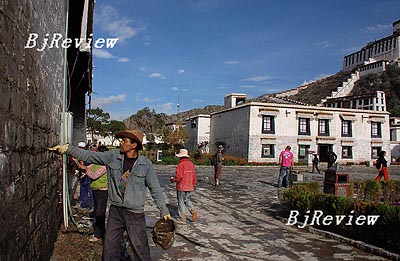
Above the entrance archway of the Potala Palace were two groups of young women, much of their faces covered by scarves, singing while they took turns fortifying the surface of the flat roof.
Their movements were so dance-like that many visitors mistook them for some kind of folk art performers. Actually, they were local workers hired to renovate the holy palace. Down at the foot of the archway, other workers were repainting the brick wall.
"We repaint the wall to prevent it from being eroded by rain and sunshine," said one of the workers, who didn't want to have his name revealed.
The workers were among the 470-strong renovation crew that has been working to repair and preserve the palace since June 2002.
"I've been to many countries including Spain, Denmark, Japan and the United States, and the Tibetan people there all think highly of the preservation work of the Potala Palace," said Qamba Galsang, Director of the palace's management office, also known as the "guardian of the Potala Palace".
Treasures
The Potala Palace, with over 2,000 rooms and 34 Buddha halls, is a huge museum full of cultural relics, including the Holy Stupa for the 5th Dalai Lama, which is wrapped with 5.5 million grams of gold and inlaid with numerous gems. However, many of these priceless treasures still have not been registered and recorded.
"That requires us to sort out these cultural relics during the repairs," said Galsang while meeting the press on July 17 in Lhasa.
"Efforts are being made to register them. So far, we have completed 16 halls and five cultural relics storehouses, involving 60,000 relics in over 5,000 archives," he noted.
But interestingly, the number of the rooms in total in the Potala Palace remains a mystery. "Many experts have come and counted and measured everything, and they threw up their hands at this question because we can never be sure how many secret vaults there are," said the "guardian".
In debriefing on progress at the palace, he said that recently the renovation team has been focusing on sorting out the storehouses of bronze-ware, ceramics, tangka paintings, garments and some others items.
"In the meantime, we have set up a special office for research. Scholars have been organized to catalogue 25,000 classics and we have already published a catalogue on the ancient religious books of the Gelug Sect and the Nyingma Sect."
In addition, to protect and also further promote the holy palace, they have published a pictorial showing the history, architecture and cultural relics of the Potala Palace.
Renovation
The Potala Palace, an almost totally wooden structure, is lit mainly by butter lamps. These, plus the fluttering silk sutra streamers, pose a fire hazard.
"My No.1 enemy is fire," Galsang proclaimed in a hearty voice. In 1984, a room in the palace caught fire due to a short circuit. The fire was quickly put out, but the damage done to holy religious scriptures alone took 20 years to restore.
The Potala Palace management administration has been working painstakingly to prevent accidents. In 1994, some 4.7 million yuan was invested to install a TV monitoring system operating 24 hours a day. And now there is a 20-member fire brigade stationed in the palace that can be at a fire within a minute.
According to Galsang the second biggest worry for the palace is theft, which has been tackled by installing the country's most advanced monitoring and anti-burglary security system.
As the Palace is hundreds of years old, its maintenance is a constant burden. According to Galsang, the renovation team invited Zhang Zhiping and Yan Hua, senior engineers with the China State Cultural Relics Research Institute and the State Center for the Protection of Cultural Relics, to conduct an on-the-spot survey in the palace for 20 days so that they could make suggestions on its preservation.
The first large-scale repair conducted at the palace was between 1989 and 1994. It cost some 55 million yuan and reinforced the major part of the palace, but the architectural complex of some 2,000 halls calls for regular ongoing maintenance. The renovation team faces a constant battle against deformation and collapse of the walls, and insect infestation of the wooden structure.
Without changing the original nature of the cultural relics, efforts have been made to reinforce them, such as adding reinforced bars in the walls and hidden iron hooks in wooden beams.
In accordance with suggestions from the experts, carpenters, painters, stonemasons and tailors were brought in to work on a dozen repair projects, and to make 500-square-meter sutra cabinets and around 200 boxes for cultural relics.
"Whitewashing the walls, extending 100 meters or more from top to the ground, calls for more than 50 tons of limestone and red powder," said Galsang.
The second major renovation of the palace started in June 2002, and was budgeted at 180 million yuan. It aimed to preserve the entire structure of the Potala Palace to ensure its firmness and security, according to Galsang.
According to Xu Fei, Deputy Director General of the Tibet Culture Relics Bureau, the second-phase repair of the palace is progressing well and will be finished within the year.
Protection measures have been accelerated at the palace since the launch of the Qinghai-Tibet Railway on July 1, 2006, but visitors remain intentionally limited. The number of tourists allowed to visit it is capped at 2,300 per day to lighten pressure on the ancient wood palace.
"The restriction of visitors proves our commitment to the protection of the Potala Palace," said Galsang. "We can't fully satisfy the needs of all tourists, but we have no other way around it."
Potala Facts
Originally built by King Songtsen Gampo in the seventh century, the Potala Palace is located on the Red Hill of Lhasa, Tibet. Destroyed by lightning and war, the palace was rebuilt by the Fifth Dalai Lama in 1645. Since then, it has been the seat of Dalai Lamas and also the political center of Tibet. The 13th Dalai Lama extended it to the present size, 117 meters (384 ft) in height and 360 meters (1,180 ft) in width, covering an area of more than 130,000 square meters. The Potala Palace is famous for its grand buildings, complicated construction, devotional atmosphere and splendid artwork.
The Potala Palace consists of two sections: the Red Palace in the center, used for religious functions and the White Palace on both sides, used as the living quarters of the Dalai Lama.
In December 1994, the Potala Palace of Lhasa was included in the UNESCO World Heritage List. |