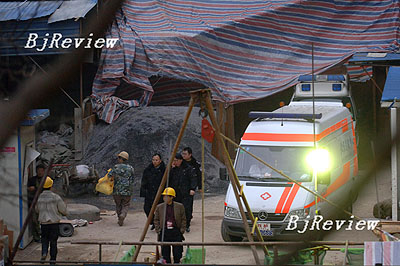
The last Wednesday in March started like every other day for people in Beijing. The mad morning commute and traffic snarls began to build as the city woke up. Construction sites around the capital reverberated with their never-ending banging. Not only above ground, but also below. And as they headed for work, few people passing overhead the construction site of the No.10 Subway Line in Haidiannanlu (Road) in the northwest of the city had any idea of the disaster playing out beneath their feet.
Behind locked doors, the construction workers had finally stopped their around-the-clock tunnel digging. It was 10:00 a.m. They had a new more urgent mission--to unearth six co-workers buried in a cave-in accident. But their boss began acting strangely. He confined the workers who took part in the rescue work to the construction site and instructed others to spray paint over the company name outside the site. He also confiscated workers' mobile phones to avoid them reporting the accident. To the workers it became clear he was covering up a tragedy. When the dust had settled, six young men had lost their lives and Beijing mourned.
The previous night workers had found a crack in the tunnel, according to a March 30 report in the Beijing Times. However, the contractor of the tunnel Zhou Yongfu ordered his staff of 60 to continue their work. On the morning of the accident, the crack widened, causing a minor collapse. It was when workers were ordered to repair this damage that the deadly cave-in happened.
The blatant cover-up attempts delayed the first-aid rescue to 5 p.m., which could have reduced the chance of survival for the trapped workers. Rescuers confirmed the next morning it was almost impossible for any trapped worker to survive. According to the Beijing Times, local police had detained 10 people over the subway cave-in by March 30, including the work supervisor and tunnel designers, but the labor contractor, Zhou Yongfu, is reported to have fled.
Dangers of subcontracting
At the end of last year, government announced its plan to build the world's biggest subway network by expanding its subway system to 273 km (169 miles) by 2010 and to 561 km by 2020. By then Beijing will replace London as the city with the world's most extensive underground rail system.
In the construction of large infrastructure projects like subways, it is common for the big contractors to subcontract the project to smaller companies, which will go on to subcontract the work to unqualified companies regardless of laws and regulations. Due to the over-subcontracting practices, the construction teams in the field, who earn very little, have neither the technical know-how nor funds to ensure work safety measures.
In the Beijing Times report, Wang Wenshan, a colleague of the deceased six workers, confirmed that excessive subcontracting existed in their company. He said their contractor had subcontracted the digging of this stretch of tunnel and hired over 150 workers to finish the job. To meet the deadline, in spite of the dangerous nature of the work, workers have to work 12-hour days.
In the wake of this catastrophe, the Ministry of Construction issued a circular on the construction safety of subway projects on April 1, which requires government at all levels to crack down on illegal subcontracting and remove unqualified construction contractors from the market.
In the same circular the ministry also demanded construction companies stick to timely reporting and rescue work in case of accidents and warned of harsh punishment for any concealment and delay in reporting.
The official Xinhua News Agency summarized the three main reasons leading up to the slow progress of rescue work. The primary reason is that rescue work was critically delayed by the seven-hour gap between the occurrence of the accident and the reporting to local police. The other two reasons are the complicated underground mass of geological factors and power grids.
Geographical explanation
According to experts directing the rescue work in field, the location of the cave-in used to be a pond 50 years ago. The backfill earth on the surface had never been tightly compacted and a layer of fine sand lay immediately below the backfill earth, whose density cannot sustain a tunnel.
"I think to absolutely avoid a disaster of this nature in subway construction remains an engineering difficulty worldwide," said Ma Yinsheng, a senior research fellow on geological disasters with Chinese Academy of Geological Sciences. He said in the pre-construction geological surveys for subway construction, the standard practice is to drill holes every dozens of meters to see if the geological texture is solid enough for sustaining tunnels. Under such circumstances, if there was a pond of less than 10 meters in diameter backfilled with earth, the odds are high that it won't be detected, which could be a hidden danger in the construction of tunnels.
Ma said besides the loosened backfill earth, another possible cause for this accident is the existence of a geographical crack, which his research team suspected during a geological study of Beijing city proper several years ago.
Ma said although Beijing was situated on a soft geological stratum, the construction of the planned subway network should have no technical difficulty from the perspective of geology. He said the most useful measure to avoid such a tragedy in the long run is to establish geological archives for every city by preserving all its geological data. This will ensure the geological situation of a region 100 years old could serve as the reference for future construction.
Yet Ma said the city geographical archives is still a new concept worldwide and has not been thoroughly established by any city in China. Immediately after China's successful bid for hosting the 2008 Olympic Games in 2001, he handed over a suggestion to the Beijing Municipal Government to collect the geological data during the city's unprecedented campaign of subway construction. "This offers a rare chance for us to gain knowledge of Beijing's geological information, which could serve as the technical reference for future projects," said Ma, who still has no idea whether his suggestion has been accepted.
Chronology of Subway Cave-in (Up to 9 a.m. April 6)
9:30 a.m. March 28 Construction site for the No.10 Subway Line in Haidiannanlu (Road) between the city's northern Third Ring road and Fourth Ring road experiences a cave-in, which traps six workers. The collapsed tunnel covers an area of about 20 square meters and is about 11 meters underground.
Shortly after the accident, project managers order workers not to talk to media or police and confiscates their cell phones.
2:55 p.m. March 28 First-aid center of police in Anyang, Henan Province receives an emergency call from the relative of one of the trapped workers. The information is leaked via a cell phone of a worker at the accident site that was not confiscated.
4:39 p.m. March 28 After getting the report from Henan police, Beijing Municipal Government confirms authenticity of the information and location of the accident and activates an emergency response plan by forming a rescue command center of officials from different departments.
Evening March 28 Beijing Mayor Wang Qishan and Minister of the State Administration of Work Safety Li Yizhong arrive at the scene to give field direction to the rescue work.
7:30 p.m. March 29 Beijing Municipal Government hosts a press conference on the accident, naming the contractor, subcontractor and supervisor of the project.
10:25 a.m. March 30 The first trapped worker is located. He shows no signs of life.
6 p.m. March 30 Rescuers recover the first body after more than 50 hours of excavation. The victim is confirmed to be 20-year-old Li Peng from Henan Province.
March 31 The bodies of another three workers are located. They are crushed by collapsed concrete. The space underground for rescuers to move is narrow.
6-8 a.m. April 1 The bodies of 37-year-old Mu Chaoqing and 37-year-old Liao Zhengjun are extracted.
1 p.m. April 1 The body of 35-year-old Zhou Congyun is extracted. |