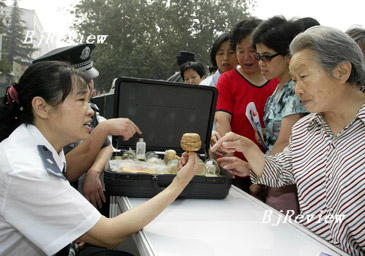
After a six-month crackdown on drug-related crimes in the city's entertainment venues, the Beijing Narcotics Control Commission declared in late December that it had cleared up 1,300 sites. The commission also said Beijing has set a goal of eradicating drugs in all public places and promoting drug-free communities in time for the Olympics in 2008.
Fu Zhenghua, Deputy Director of the Beijing Municipal Public Security Bureau, said that after "waging a people's war against drug crime," the police had eliminated drugs in 1,300 entertainment venues. "This is a hard-earned success for such a large metropolis like Beijing, and we are very proud," Fu said.
"But this is just a preliminary success in the campaign against drugs. We hope to clear up all the city's public places by 2008," he added.
Since the campaign began in June, relying on careful checks and secret inspections, police have examined 1,300 entertainment venues, of which 38 have been punished for drug-related violations. Among them, two entertainment venues where drugs were being used were shut down and another 11 were temporarily suspended from doing business.
In the first 11 months of the year, police solved 3,620 drug-related crimes, seizing 4,065 suspects, of which 1,080 were involved in drug trafficking. The number of cases represented a year-on-year increase of 12.8 percent, said Zhao Wenzhong, section chief of the bureau's anti-drugs section.
Police arrested 24 foreigners in cases involving drugs in 2006, he added.
"We also introduced a tip-off system for the public to use, a blacklist for the entertainment venues and an appraisal system for policemen," Zhao said. The police encourage people to report cases of drug use and people who report actual cases will be amply rewarded, he added.
Entertainment venues where drugs are taken or sold will be blacklisted and exposed through the media, he said. People caught taking drugs or otherwise connected to drug use will not be allowed to operate or work in entertainment venues.
Besides applying stricter oversight to entertainment venues, police will also be reprimanded if they fail to stamp out drug-related crime within their precincts.
To strengthen the drug control effects, the police also design training courses for the managers and owners of the city's 1,300 entertainment venues. The courses discuss the harm of drug use, how to identify drug-related behavior and how to report such activity to the police.
According to Zhao, every entertainment venue will have a drug control publicity agent who is selected from its staff. These agents will receive 15 days of training by the police and they are responsible for reporting to the police in real time if they find evidence of drug use or paraphernalia.
"Entertainment venues have become the seedbed for drug abuse, so it remains a main task for us to control the drugs in these places in the future," said Fu of the Beijing Municipal Public Security Bureau.
A 'people's war'
In 2005, with the number of both drug arrests and officially recognized drug addicts on the rise, Chinese authorities responded with a call for a more stringent war on drugs.
In April that year, the Political Bureau of the Central Committee of the Communist Party of China held a meeting to discuss an anti-drug policy. President Hu Jintao chaired the meeting and called for a "people's war against drugs."
Right after that, the State Council released a five-year anti-drug plan. Since then, greater efforts in fighting drugs have been evident in China, with more integrated law enforcement, more comprehensive public drug awareness campaigns, more flexible treatment and rehabilitation measures, and more productive international cooperation.
|