|
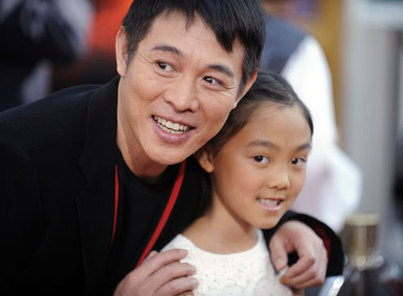
Cast member Jet Li (L) and daughter Jane attend the premiere of the film "The Mummy: Tomb of the Dragon Emperor" in Los Angeles July 27, 2008. (Photo: chinadaily.com.cn/Agencies)
Universal Pictures film The Mummy: Tomb of the Dragon Emperor is proving itself to be a money spinner on the Chinese mainland despite extensive criticism and controversy.
"The box office is within expectation and is normal for an entertainment blockbuster," Jiang Wei, general manager of the EDKO (Beijing) Film Distribution, was quoted as saying.
The third installment of the adventure series sees explorer Rick O'Connell, played by Brendan Fraser, and his family battle in China to save the world from a resurrected ancient Chinese emperor, played by one of China's biggest stars, Jet Li.
Its Chinese setting, with a reference to China's first emperor, Qinshihuang, and the terra cotta army in his tomb, has attracted Chinese audiences, but also led to broad criticism.
An online poll on one of China's major portals sina.com.cn, showed that about 52 percent of voters said they didn't like the movie because they felt it trampled on the Chinese culture.
Another 34 percent seemed ambivalent, saying the 150-million-U.S.-dollar blockbuster is just "so-so". Only 14 percent of cinema goers said they liked it.
Most Chinese bloggers, who started slamming the movie even days before the it officially opened, complained about the "absurdity" of the plot.
"Even though it was not made explicit, every Chinese with a little commonsense could tell that the emperor in the movie is Qinshihuang. China's first emperor was turned into a monster with three heads...this is illogical and quite unacceptable," a blogger named Shuifang wrote.
"To many Westerners, perhaps mummy and the terra cotta warriors fall into the same category. But to Chinese, they are totally different. People with 'patriotic fervor' will probably flare up when watching terra cotta warriors being chopped into pieces," another blogger Jinyujian wrote.
Blogger Yuyueniao listed ten major flaws of the movie, including plot loopholes, jumbled Chinese factors and poor understanding of Chinese history. "I felt the movie is quite disordered and it's so disappointing," he wrote.
However, others argued that the critics were being too serious with an entertainment product.
Wang Tao, a government employee, said the Mummy was not meant to be a history textbook.
"Really there is nothing unique about the plot, but its sound effects and some of the trick shots are quite impressive. It's a fabricated adventure story like many other Hollywood movies. Why should people be so serious?"
Jet Li, the main actor, also tried to appease critics by saying that the movie is only a commercial product and totally fictional.
"The director made a blockbuster by piecing together all the money-making elements and hoping people could have fun with it," Li said in an interview posted at the Sina.com.
"China has never had mummies and the movie presents a imaginary world. It has nothing to do with history and authenticity," Li said.
Despite the Chinese elements, which might have contributed to its box office success in China, critics said the fact that no other blockbusters were shown during the past week might also have helped.
The movie's distributor originally planned its release in late July before the Olympics, but later adjusted the plan to release it in China after the Olympics so as not to compete with the Games.
(Xinhua News Agency September 9, 2008)
|