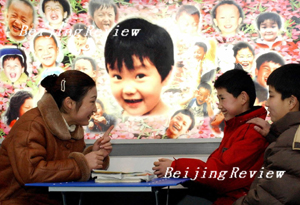
At a party for her seventh birthday in January, Tao Honghong smashed her birthday cake on the floor after wrangling with her friends. Over the next few months, she threw things at the slightest provocation. Her parents tried to get her to change her habit, but were unsuccessful.
More recently, Honghong had trouble sleeping and a poor appetite, and sometimes felt lightheaded. These symptoms gradually caught the attention of her parents. Her father took her to several hospitals and spent a lot of money, but with little effect. A doctor then suggested Honghong's parents take her to the hospital's mental health department.
Honghong has always been a good student and is regarded as a perfect child by her neighbors. However, to her parents' great surprise, Honghong was diagnosed as having obsessive-compulsive disorder.
Psychological consultant Zhou Zhenyou said that children with excellent school performance suffer from the illness not because of problems related to performance, but because their parents do not view their strengths and good performance in an appreciative way. Chinese parents tend to judge their children by a standard of perfection and are intolerant of flaws, which leads to serious mental problems in the children.
As Zhou described the syndrome, Honghong's father recalled scenarios that conformed to the expert's description. For instance, he deliberately avoided praising his daughter even if she did an excellent job at school, for fear that "she would become too proud." He found that Honghong has a habit of checking doors and windows again and again to see whether they are closed, but instead of considering it an illness he thought it is because his daughter is "responsible." Moreover, Honghong likes to wash her hands over and over again, and he was glad, thinking that she likes to be clean, which is good for a girl. Even if Honghong behaved unusually, her parents never related this to psychological illness.
Experts say this case is very typical. Many parents do not treat their children's unusual behavior or emotions as a kind of illness, believing they are a natural part of growing up. "As a matter of fact, those unusual behaviors are signals that the children are seeking psychological support," said Dr. Liu Jin from the Chinese Center for Disease Control and Prevention.
Liu noted that the psychological problems of children can be classified into three categories: emotion, cognition and behavior. She said the majority of parents, and even doctors, lack knowledge of psychological illness, resulting in ignorance about the unusual behavior of children and a delay in medical treatment.
"When looking for medical treatment, the parents usually go to a children's hospital first, or the pediatric department in a comprehensive hospital. Then they will go to the neuropathic department, then the traditional Chinese medicine department. After all those efforts end in vain, some of them will finally go to the psychology department. But at this stage, their children may have suffered a long time from the illness," she said.
|