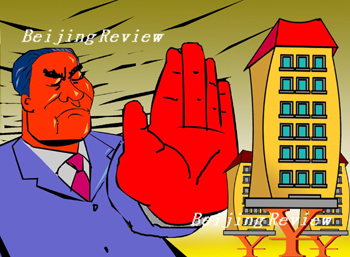
The sky-high house prices are nothing new in China, especially in metropolitan areas like Beijing, Shanghai and Shenzhen, where houses in prime locations can fetch prices as high as those in London, New York and Tokyo.
People with an average monthly salary of between $400 and $500, the group most affected, face enormous pressure, both psychologically and financially, when required to repay bank loans on their new home. This has led to a new relationship where homeowners feel they are slaves who have to give their salaries to banks.
According to a survey conducted by giant domestic web portal Sina.com, of 15,014 participants, over 90 percent of those surveyed chose to buy an apartment through a mortgage loan. Among them, 54.1 percent spend between 20-50 percent of their salaries repaying the loans monthly, while 31.8 percent spend 50 percent or more of their monthly salary. International practice has shown that one third of the monthly salary is the maximum line for mortgage loan repayments. If the loan surpasses that line, it has been found that households bear great repayment risk and a decreased standard of living.
Some of the reasons for the astronomically high prices of Chinese houses are irrational, while others are the result of corruption. In recent years, even though the government has been promulgating regulations to control ever-increasing house prices, this has had little effect. After all, the real estate industry is one of the engines driving the gross domestic product (GDP) growth in many areas. Local governments seem reluctant to respond positively to the Central Government's policy.
Faced with these high prices, homeowners have taken a stand. At the end of April, a Shenzhen resident, Zou Tao, issued an open letter on the Internet calling for a boycott on buying apartments across all walks of society. In the letter, Zou criticized the rocketing house prices in Shenzhen, appealing, "if we are going to buy an apartment now, we will have to shoulder a lifelong debt and we may spend our entire life and energy on a single apartment." He asked a question, if people were burdened by the weight of loan repayments, would they be destined to live their lives as slaves to their debt?
Zou called for people to unite and stop buying apartments for at least three years so as to cool down overheated prices.
Zou's appeal received a large response from across the country with many specifically targeting cities with high house prices. According to an online survey jointly conducted by the China Youth Daily and Sina.com, almost 80 percent of the participants support a boycott.
Zou's next move was to write to real estate developers, pointing out that the real estate industry is making exorbitant profits. He challenged the industry by asking if any real estate developers were prepared to reveal the costs behind apartment development.
The open letter was a direct message to Feng Lun, Chairman of Vantone Group, and Wang Shi, Chairman of Vanke Group, two real estate tycoons.
In reply, an adamant Feng said, "It serves them right," referring to many people becoming burdened with mortgage payment debt. Ren Zhiqiang, chairman of Beijing Huayuan Group, nailed his colors to the mast, saying "We only build commercial houses for people with high incomes." Needless to say, these comments didn't go down well with homeowners and prospective buyers.
The housing boycott is seen as an outlet for ordinary people to express their anger over what they see as an unfair state of affairs.
But not everyone is supporting the boycott. Some have questioned this movement, calling it wishful thinking and saying it is doomed to fail as it goes against the flow of market economy principles.
Chance of success slim
Qiao Xinsheng (professor at Zhongnan University of Economics and Law): Some sociologists believe that social movement is helpful to resolving problems. However, from my point of view, this house-buying boycott is just a game by netizens and will not exert any influence.
A boycott is an organized refusal to purchase products or patronize a store, to damage the producer or merchant financially, influence the policy and attract attention to a social cause. The term is derived from the time Irish citizens ostracized notorious land agent Captain Charles C. Boycott during Ireland's Land League rent wars in the 1880s.
Zou's move is a kind of boycott, but with little effect. It is because the real estate developers are not isolated in doing business. Real estate developers, relevant local government departments, commercial banks providing loans and homebuyers have formed a common interest group. This group is so strong that ordinary consumers won't make a dent in it.
First of all, when real estate developers feel that apartment sales are being negatively influenced, they can quickly shift the risk to the commercial banks and local governments. In fact, of all the links in real estate development, developers reap the biggest share of profits, but shoulder the smallest risk. The so-called boycott will have no effect on real estate developers.
Second, although the boycott movement may influence local governments' decision to some extent, government and real estate developers share an enormous interest brought about by the real estate industry. Therefore, local governments will not change their housing policy easily. That is why the Central Government's call for a decrease in house pricing fell short of its expectation.
It is hard to accept the fact that one day house prices will drop significantly, meaning the house they've bought is not worth its original price. They will feel it is unfair that those who buy after them can get apartments at far lower prices.
The Internet provides a good place for people to vent their anger, but the idea of achieving some kind of financial objectives through web politics will have little effect.
Boycotts will only work when all relevant government departments stick to the letter of the law. Under current circumstances, the boycott will fail.
Dong Fangyu (China Business): An online survey shows that almost 80 percent of people support this boycott. But in my opinion, even though many people are in favor of Zou's proposal, those who want an apartment are actively saving up the money for their future dream house, while netizens who cannot afford property are the ones keen to boycott.
I don't look down upon the low-income group, but the participants of the boycott differ widely from those who demand a house.
On the one hand, we need to affirm the message reflected in the boycott, that is, when a citizen's right is at stake, they will take actions to protect their interests. On the other hand, we must be wary of the tendency to use collective actions as an outlet for the spiteful. If we carry out a serious survey, we may find out that consumers, who plan to buy anyway, will always remain the silent majority.
Establishing a communication mechanism with low- and medium-income groups is important for social harmony.
Change possible
Zhao Xiao (professor at University of Science & Technology, Beijing): I applaud this kind of boycott as it serves to stop the current rampant spread of housing.
China's land value is worth an estimated 30 trillion yuan, far more than the overall assets of state-owned enterprises, the market value of all stocks, or the country's total deposits. The majority of land is public property. To carve up the land, which belongs to all the people, by manipulating power and money deeply besmirches the process of effective urbanization and is detrimental to social harmony.
The masses need to find a way to express themselves and re-establish the rules of China's real estate development. The purpose of the boycott is to establish a legal and effective way to deal with this social pressure and stop the current real estate development mode.
As is known to all, the "success" of the real estate market not only stems from market demand, as some real estate developers claim, but other factors are also involved. The most notable of these is the alliance formed by local governments and real estate developers. This kind of alliance leads to an abnormal growth pattern, in which the real estate developers take the lion's share, the local government is rewarded with GDP growth, and all the costs are shifted to the shoulders of ordinary citizens.
What does it mean? Local governments need to build a lot of projects and extravagant buildings to show off their performances, while real estate developers depend on the governmental power to demolish local dwellings and appropriate land. A marriage made in heaven. The huge social and public damage caused, such as environmental destruction, the loss of interest and profit of farmers who lose their land, the bad debts and the tax losses, have all been ignored in the name of development and urbanization. Obviously, it is a shortsighted development mode and may even be called plunder. Local officials and real estate developers are smiling all the way to the bank. However, the majority of people cannot share the profit brought about by the industry, which causes a huge disparity between developers and the people.
Cao Jianhai (researcher at the Chinese Academy of Social Sciences): Zou's behavior is totally voluntary and he has acted out of the good conscience of a citizen. When house prices continue to soar, what can the public do? The only thing is to safeguard their pockets. Although the real estate industry can raise house prices at will, what the industry fears most is the loss of profit brought about by decreased purchasing in the wake of a price hike. If Zou's call is effective, it means that the people are striving to solve the real estate problem in a most rational way. First, facing a boycott, many real estate developers may be cleaned out and face huge bank loans of their own. Second, local governments will no longer auction or sell land to the people who already own it. Third, farmers will suffer less from the government purchase of land, and they may enjoy a relatively stable lifestyle. Finally, a decrease in house prices will activate the second-hand housing market.
|