An expert recently suggested setting up a national reform commission directly under the Central Government so as to accelerate the formulation of reform plans and policies to transform China's development mode.
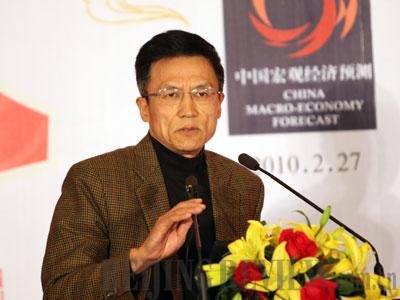
"China should establish an independent national reform commission to tackle the problems brought by China's traditional economic growth mode, which mainly depends on investment and exports," said Xu Xiaonian, a professor at the China Europe International Business School.
The traditional economic growth mode driven by investment and exports has hit a dead end and no longer benefits the people, Xu said at the 2010 China Macro-Economy Forecast Annual Spring Conference, held by Capital Week, a famed Beijing-based magazine that specializes in securities news.
Xu noted at the ninth annual conference on February 27 that during the process of China's economic development, residents' consumption rate has experienced a continuous drop as a percentage of gross domestic product (GDP), leading to a decline in people's living standard due to the facts that income growth is slow and the rate of saving lags far behind housing prices. The public is receiving less and less benefit from the distribution of economic gains. Thus, the country may forget the purpose of its economic growth.
Calls from the government are not enough to remedy the serious defects in the traditional economic growth mode, Xu said. China must transform its administrative system. Without a significant breakthrough in the managerial system, it will be difficult to achieve fundamental change in the economic growth mode.
"Transforming the economic development mode is not as simple as coming up with a slogan and erecting a policy, but requires fundamental reform," Xu said.
Over the past dozen years, Xu said, China has not achieved any obvious practical breakthroughs in transforming its economic development mode. The reason is that each new reform measure faces resistance from various sectors. "The current administrative system is an obstacle which impedes the transformation of China's economic development mode," Xu said.
He said that what China needs most now is to speed up system restructuring and intensify system innovation. "The establishment of a new reform commission would help promote the restructuring effort because the new commission, directly under the leadership of the Central Government, would be free from interference from various government departments and social interest groups. Departments would no longer be able to consider only their own interests when designing plans for reform.
"China needs such a national reform commission that is directly under the Central Government and has no relations with any government department or local government," Xu continued. The commission could consider a wide range of suggestions from people from all walks of life, and research and formulate economic and political reform plans without any interference. "If staff is needed for this commission, I would be delighted to be the first volunteer," Xu said.
Background
Established in 1992, Capital Week was one of the earliest magazines concerning the securities market and is the only magazine to publish listed companies' information authorized by the China Securities Regulatory Commission.
The China Macro-Economy Forecast Annual Spring Conference is an economic forum held by the magazine. The conference enjoys wide influence in the fields of economy and securities media. This year's forum focused on how the global financial crisis has transformed world economic patterns, as well as how low carbon has transformed development modes worldwide.
(Source: Caijing magazine)