|
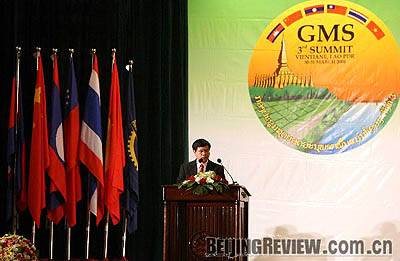
Endorsed at the Third Greater Mekong Subregion (GMS) Summit held on March 29-31 in Vientiane, capital of Laos, the Vientiane Plan of Action covers more than 200 projects in nine terms, including transport, energy, telecommunications, agriculture, environment and tourism, with an expected total investment of $20 billion.
The participants of the Summit were leaders from the six GMS member countries - Cambodia, China, Laos, Myanmar, Thailand and Vietnam - as well as Asian Development Bank (ADB).
How will investors seize investment opportunities? What problems still exist in terms of trade, among GMS member countries? With these questions, and more, 21st Century Business Herald recently invited ADB Economist Ronald Butiong and Chen Tiejun, Research Fellow at the Chinese Academy of Social Sciences in Yunnan, to view their opinions on GMS's current situation and its future. Butiong is in charge of the GMS Program, while the latter has, since the mid 1990s, been actively involved in GMS research.
Investment opportunity for private investors
21st Century Business Herald: What business opportunities will GMS development offer?
Ronald Butiong: The total investment for the projects in nine categories is expected to reach $20 billion, in accordance with the Vientiane Plan of Action for GMS Development for 2008-2012, signed on March 31.
Part of the investment is slated to be invested by public finances, and others from private investors. Currently, some specific projects are in the middle of talks, and some power plant projects have got investments from private businesses. Detail rules on private investors' participation are under further discussion, in accordance with multiple strategic research results.
ADB got involved in 34 projects valued at over $10 billion. It offered one-third of its investment, with the remaining $3.5 billion coming from GMS member governments, and the other one-third from other approaches, including private investors.
How will private businesses invest in GMS projects?
ADB will adopt the method of inviting bids internationally for these projects, which are to be published on the Opportunities column on ADB's website (http://www.adb.org/), which private investors may consult and then apply. As for the remaining projects, enterprises may directly contact local governments.
How will these projects impact southern China's economy in terms of successfully implementing the five-year plan?
Carrying out all the GMS projects, including those that the ADB is involved in, will spur further development in this area, and thus help poverty-stricken areas alleviate their burden of distress.
For other GMS member countries, projects in China are provided with a vast market, a population of 1.3 billion. Conversely, GMS countries are doors for China to enter Southeast Asian markets.
Obstacles in the path of GMS's sustainable development
How is GMS development progressing?
Chen Tiejun: Overall cooperation between GMS member countries is underway. Three highways, known as three economic corridors in terms of transport -- Kunming to Hanoi, Kuming-Bangkok and Kunming to Rangoon -- are on the GMS cooperation plan list and are basically open to traffic.
The three economic corridors are designed to improve GMS infrastructure facilities. Chinese Premier Wen Jiabao said at the summit that the Mekong Subregion features low economic development, lack of finance, and poor infrastructural facilities. Construction in Yunnan Province began from building the three economic corridors, aimed at tapping potential resources, and changing the resources of the three economic corridors into economic advantages, so as to realize the main goal of poverty relief.
At present, the member countries maintain sound cooperation in terms of trade, industries, and foreign investment. Vietnam and Myanmar have become the largest counterparts of Yunnan. With their own separate advantages, they complement each other.
What problems exist currently in terms of trade?
As it maintained close trade links among these member countries, China came across two problems.
One was that the long-term favorable balance of trade could produce an imbalance. Target countries, saddled with backward economic development and low productivity, do not have enough commodities to export. This scenario may produce a negative impact on the sustainable development of trade, or even lead to a complete halt in trade.
The second problem is the unreasonable trade structure wherein China provides industrial products and the target countries provide primary products. This may result in an unequal distribution of benefits, an issue that may damage the further expansion of trade and economic cooperation.
As a result, the Chinese areas in the realm of GMS, should, in addition to trade, rev up investment to member countries, strengthen industrial cooperation, export labor and develop resources, thus transferring resource advantage to economic advantage.
(Source: 21st Century Business Herald) |