|
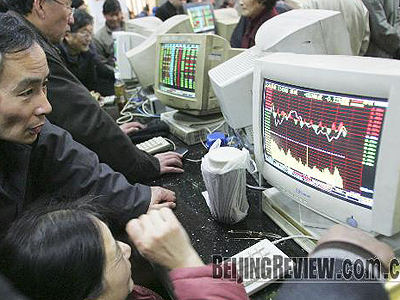
Since becoming China's first catering business to go public, Quanjude's share price soared 466 percent to 64.53 yuan ($8.90) on January 19 this year, despite the fact that it was suspended from trading several times during the period.
Quanjude, or Peking Duck, is a well-known chain of roast duck restaurants listed in the Shenzhen Stock Exchange last November. In the eyes of individual stockholders, this "duck" contains two concepts -- China's No. 1 chain of restaurants, and a good business related to Olympic Games.
"Every foreigner coming to Beijing to watch the Olympic Games will go to Quanujude to eat roast duck," said an individual investor whose last name is Shen, full of confidence. "So it goes without saying that these stocks have become the king of all the stocks."
However, the conspicuous "duck" drew the attention of the Shenzhen Stock Exchange, and an investigation was launched following its eighth limit-ups. The stock subsequently suffered from two limit-downs at a time. The Central Government set 10 percent limit-ups and limit-downs respectively each day in a bid to control over-fluctuation.
Still, the two limits-downs didn't suppress the confidence of many investors who believed that the Olympic story was just starting, and that stocks related to the Olympics would perform better in time. And they did. They went up in sync on the first stock-trading day in 2008, signaling that the investors' faith had been well placed. 15 stocks went up by 10 percent, and 43 over 5 percent.
At the end of 2007, although the stock market was in a period of downturn, stocks with the 2008 Olympic concept started to rise dramatically, spearheaded by China Sports Industry and Beijing Capital Tourism. The former's stocks rose by 148.3 percent -- from 16.62 yuan to 41.27 yuan -- and the latter's went up 73 percent, from 30.66 yuan to 53.07 yuan, in merely 45 days, starting last November. Other stocks, belonging to companies such as Beijing Jingxi Tourism Development and Beijing Xidan Market, followed suit. This spurred other investors to invest in the section, taking it to a record high.
After studying the experiences of various countries that have held the Olympics, several institutions predicted boldly that stocks in the Olympic concept section were expected to earn the most in 2008.
According to Orient Securities, the host country has usually seen a boost to the economy and stock markets, especially for an emerging market holding the event for the first time. Enterprises dabbling in projects related to the Olympic Games will be benefited, find new development opportunities from the Games, and will elevate their brand name.
In accordance with the features of the Olympic Games, the event has been divided into three phases by many institutions.
The first phase, the period prior to the event, is drawing to a close. During this phase, shares related to stadiums and infrastructure projects draw the attention of stock investors.
The second phase is the period during the competition. Stocks related to consumption will become popular in the year of the Games. This is why recent share prices for companies such as China Sports Industry, China CYTS Tours Holding Co. Ltd. and Beijing Xidan Market have soared.
The third phase is the post-Olympic period, when, due to the shortage of demand, economy and investment are expected to decline.
With the Games approaching, the capital market, as if not satisfied with the "imagination" in the first phase, began to enter the second phase ahead of time. Investors are pursuing practical gains and plan to leave the market successfully in the third phase.
However, many also consider the overvalued Olympic-related shares risky. Security research institutions are advising investors to evade risks.
A report from Guotai Junan Securities suggests that investors in Quanjude shares should be wary of the risks involved. According to the restaurant chain's 2007 year-ending financial report, the net profit was 57.48 billion yuan ($7.9 billion), a rise of 145 percent increase year on year. Its earning per share, standing at 0.41 yuan, was lower than expected, and the figure in 2008 is expected to reach 0.7 yuan. Considering the share price, the earning ratio is considered to be too high.
Guotai Junan Security, along with some other security companies, held that the duck share should value at 35 yuan, only half of the current price. The current situation indicates that the high-price shares are spurred by funds from investors. Nevertheless, some shares, like those of Beijing Capital Tourism and Beijing Xidan Market, seem to be sharing the same syndrome.
Firstly, the Olympic Games themselves do not last very long. Although some affiliated companies will see a temporary expansion, and businesses such as the tourism industry and large shops will flourish briefly, they will not grow as imagined.
Secondly, much will depend on commodity supply and demand.
"All Olympic-concept shares will have a popular rise at first, and then will go according to price discrepancies," said Wei Daoke, analyst with Shenyin & Wanguo. "Following profit-taking, these shares are likely to go down, and the stock markets, perhaps, will lost zest for these high-price stocks before the Games open formally."
Analyst Zhang Xiang with Guodu Securities reminds medium and small investors to keep a sober mind while investing. He praises managers of public offering funds, who haven't blindly chased after Olympic-related shares.
Some securities institutions pointed out that the current hype for Olympic-concept shares indicated that investors bought shares in a narrow-minded way. The most popular shares are mainly from Beijing, as if only listed companies in Beijing are able to benefit from the big event, which is obviously not logical. Now, the most popular stocks in the markets belong to businesses such as trade, tourism and real estate. In fact, aviation, transportation, and Olympic mascots will also benefit from the Games.
The securities companies suggest, therefore, that investors should clearly recognize that these shares, having risen so high, will also drop by a large margin once the market begins readjustment.
For stock investors, it is certainly necessary to closely follow the performance of Olympic-themed stocks in Beijing, but they also need to extend their focus to Olympic business sponsors such as Qingdao Haier Joint Stock and commodities suppliers. It is a foregone conclusion that the stocks of these companies are high likely to soar, considering their above-average business performance.
(Source: Southern Weekly) |