|
 |
|
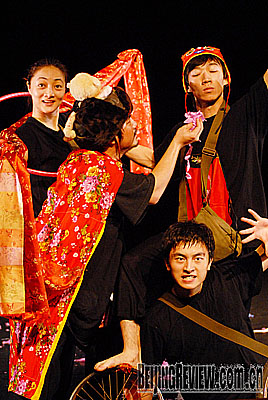
GET OUT OF MY FACE: Two characters in the play Porcupine-style Love, a mini-theater production staged in July 2008 (WEI YAO) |
In a world where bigger is often seen as better, entertainment, especially the world of theater, has gone full circle and returned to smaller, more cozy productions that allow both the directors and the audience more freedom of interpretation and expression.
Established in 1953, the Beijing People's Art Theater on the northern end of Wangfujing Street, Beijing's most popular pedestrian-only commercial street, has a colorful past, cataloguing a stream of trends, thoughts and ideas on stage for 55 years. In 1995, a new concept in theater was introduced in. The former canteen of the Beijing People's Art Theater was changed into a smaller theater. Aptly called the Mini Theater, this intimate location seated only 200 people for its first performance. Struggling with a paltry 1,000 yuan (around $143) as start up funds, the Mini Theater was a shabby environment with creative ambitions. In the years that followed it persevered and has gone on to become a regular stop for patrons following Beijing's theater trail and provides the perfect venue for this genre of stage production.
Introducing mini theater
The concept of mini theater was first seen in China in 1982, when director Lin Zhaohua staged the play Absolute Signal in a small rehearsal room of Beijing People's Art Theater. It was originally set only for a small audience to allow discussion about the play afterward, but went on to attract more and more people. Absolute Signal became known as the pioneer of experimental plays in China.
But Lin refuses to accept the title of "experimental play director."
He said it is a shame if there is only one form for plays. "I want to direct a play in different ways. The difference comes naturally and is not made by us," said Lin
Three years later, in 1985, Lin went to Europe and found this form of mini theater had already existed there for decades.
With the success of Absolute Signal, mini theater gained in popularity and introduced a string of experimental directors to the theater hungry public.
Meng Jinghui became the most well-known of these directors. His name is now synonymous with mini-theater plays. Starting his directing career in 1990, Meng's stage successes have become study material for students in the Central Academy of Drama of China.
"To me, experimental plays mean innovation. I don't want to be a follower, and I want to use language and methods that can be accepted by young people," said Meng.
Chen Jianbin, an actor in Meng's play The Accidental Death of An Anarchist, said he was initially totally confused by Meng's direction style. "During rehearsal, when Meng was not satisfied with the acting, he just let the actors try over and over again without telling us his idea of how to do the acting," said Chen.
To this, Meng said he wanted the actors to feel the play by themselves and act in the most natural way they could. "I cannot tell them how to do the acting. If I do, it is just my idea, which would be narrow and limited. I want the actors to explore more about the story by themselves." This directing method has made him stand out in the genre.
Meng has persevered with his methods despite many setbacks. When he started his play career in the 1990s, it was very hard to move forward since few people knew what his works meant. "We had to make many calls to invite people to come to watch the plays since nobody would buy the tickets," he said. Now, things are getting much better and mini theater has got more acknowledgement. "I am a stubborn person. I want to stick to my own way and my way is just to try new ways and make the best plays in China." said Meng.
|