|
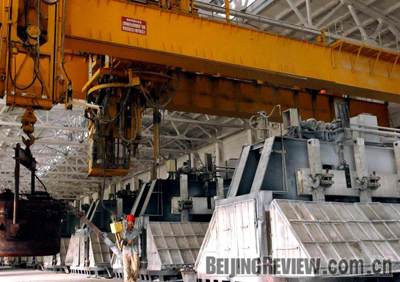
SCALING DOWN: China's rare earth companies, including the Aluminum Corp. of China's factory in Guangxi, have cut their production to try to stabilize the prices of mineral resources
The prices of lead and zinc also have fallen dramatically. China is a major global supplier of lead and zinc, but its exports of them have dropped markedly this year. With continuously increasing production costs, the companies' operations have reached a critical point.
Statistics from the CNMIA indicated that in 2007, the output of China's 10 nonferrous metals totaled 23.61 million tons, ranking first in the world for the sixth consecutive year. Zinc prices on the international market dropped from $4,166 per ton in May 2007 to less than $2,000 per ton in July 2008. Lead prices also fell from $3,895 per ton in October 2007 to $2,116 per ton in July 2008.
Among resource products, copper has maintained a strong price. In April and July, copper prices hit $8,889 per ton and $8,940 per ton, respectively. But since the end of July, they started falling markedly. By August 12, copper prices had dropped to $7,120 per ton, a decline of 20.35 percent compared with their high point in July.
Li Kun, Vice General Manager of Sichuan Hongda Co. Ltd., whose major products are lead and zinc, has said on several public occasions that cutting production may be the only thing for companies to do now and that it was wise to do so to stabilize prices.
Resigned choice
But cutting production to stabilize prices is a resigned choice for some industry executives.
Fan Jianping, Chief Economist of the State Information Center, told Beijing Review that under the present background of the economic slowdown and increasing inflation, the problem of excess capacity in the manufacturing industries has become apparent. As raw materials for manufacturing industries, resource products are suffering from declining market demand. Under such circumstances, even cutting production would not guarantee that prices would rise as they have done in the previous two years, he said.
Fan said prices fluctuate naturally, and price drops of resource products are decided by inherent supply and demand factors. In the past two years, the prices of major resources and basic raw materials have kept rising, so that a downturn adjustment has become inevitable.
The slowdown of world economic growth has caused the market demand for some resource products to drop off, Fan said. The nonferrous metal industry in particular has stepped onto a downturn track, he added.
Wang Feng, a nonferrous metal industry analyst at Everbright Securities Co. Ltd., told Beijing Review that cutting production to try to stabilize prices was a feasible measure for the short term, but could not alter the downturn trend of resource industries such as the nonferrous metal industry. Because of excess capacity, inefficient demand was the major reason for the continuously falling prices of resource products.
"Cutting production won't alter the situation of supply and demand of these products," Wang said.
Little effect
When BSREHT declared a one-month suspension of production on May 29, the prices of neodymium oxide and praseodymium oxide were 170,000 yuan ($24,927) per ton and 150,000 yuan ($21,944) per ton, respectively, on the Shanghai spot market.
But on September 10, the prices of neodymium oxide fell to 120,000 yuan ($17,595) per ton, a drop of 50,000 yuan ($7,331) per ton compared with May 29; the price of praseodymium oxide was 110,000 yuan ($16,129) per ton, a drop of 40,000 yuan ($5,865) per ton.
Prices of aluminum, copper, lead and zinc also have fallen during the past month. A report released by TX Investment Consulting Co. Ltd. on September 9 said the companies' production cuts had failed and future prices would continue to fall.
But during the month when 27 lead and zinc companies jointly declared that they would cut their production on July 12, the output growth increased. In July, the zinc output reached 331,200 tons, up 18.6 percent year on year, which was higher than the 8.3-percent growth during the first seven months.
Wang said the cuts in production by the lead and zinc companies can be deemed as a kind of self-preservation aimed at balancing supply and demand by reducing supply during a sluggish period and tiding over the industry's difficulties. But for the time being, reducing production to stabilize prices would have no effect, he said. |