| 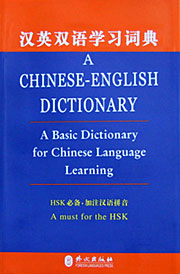
A Chinese-English dictionary based on standardized proficiency vocabulary is quite necessary for any foreigner learning Chinese who wishes to pass the Han Yu Shui Ping Kao Shi (HSK). Until now all other existing dictionaries were compiled for native Chinese users according to the 8,000 Chinese characters needed for proficiency with entries translated into English in some of these dictionaries. Before the debut of this new dictionary, all the others were designed for Chinese users to be used as tools for English translation
To fill the gap, the Foreign Languages Press organized more than 20 editors and translators to labor on this Chinese-English Dictionary. In October 2007, after five years, the dictionary has been published.
The new dictionary comprehensively covers "Chinese proficiency vocabulary", plus all the first letters are arranged alphabetically, in Pinyin, while homophones are arranged according to strokes and homophones with the same strokes are ordered based on the first stroke.
In terms of interpretation, not only commonly used meanings but also some rare and dialectal meanings are included in the dictionary. Interpretations are brief and to the point with less explanation of basic knowledge and more focus on vocabulary pertaining to Chinese culture.
Given that Pinyin is the most convenient method for foreigners to learn Chinese, all the first letters, example words and sentences are marked with Pinyin, which is quite different from other dictionaries. The example words and sentences are vivid and collocations are carefully designed. The dictionary also includes common idioms, proverbs and slang, as well as the explanation of words literally difficult to understand.
Due to the complexity of Chinese, quantifiers and several parts of speech designated for a single character in the Chinese language are not easy for foreigners. Thus, parts of speech have been marked according to the words covered in the dictionary along with appropriate quantifiers that may accompany them as well.
This dictionary is well designed and comprehensive, making it quite helpful for foreign Chinese learners. Xiao Xiaoming, Qian Wangsi, Yao Naiqiang and Wu Xunnan, along with the Chinese and English editors in chief, including Qian Wangsi, Wu Xunnan, Yao Naiqiang and Li Zhenguo, designed the dictionary.
The tome has about 1,500 pages, covers 2 million words and costs 79.00 yuan (U.S.$10.64).
(China.org.cn November 19, 2007)
|