
|
| Xinjiang Today |
| Between two deserts | |
|
|
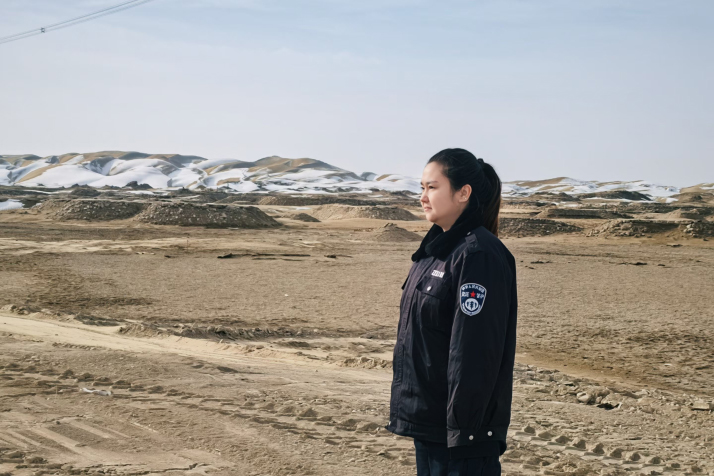 Forest ranger Nabire Aimaier (COURTESY PHOTO)
On a spring morning at the southeastern edge of the Taklimakan Desert, 52-year-old Aimaier walked slowly along an irrigation canal, a shovel resting on his shoulder.
The canal stretches 130 km between two villages in Ruoqiang County. Water stored from the previous year's floods had begun flowing through it once again, spreading across the desert fringe where native vegetation awaited the season's first nourishment. Whenever he spotted a patch of land the water could not reach, Aimaier used his shovel to level the ground, guiding the flow toward thirsty roots. He has spent most of his life doing work like this. "There used to be much less green here," he said. Standing beside the canal today, it is difficult to imagine how fragile this landscape once was. For decades, the Taklimakan and Kumtag deserts, China's largest and sixth largest expanses of sand, advanced toward each other, threatening to swallow the narrow green corridor separating them. Had that corridor vanished, the two deserts would have merged into a single, unstoppable sea of sand. Keeping that from happening is Aimaier's lifelong pursuit. Before him, his father led the charge; today, his daughter stands alongside him. This is the story of three generations who stood between the encroaching sands and the land they call home. 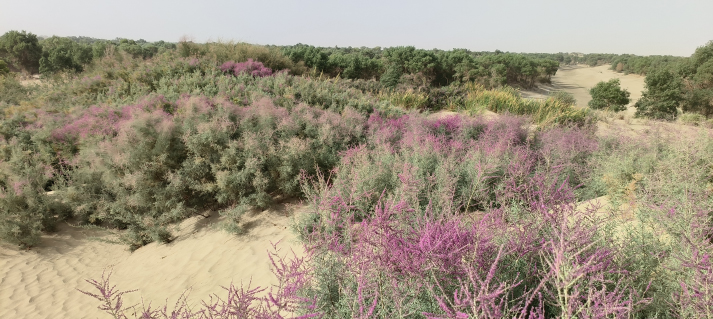 Desert vegetation along both banks of the Tarim River is nourished during the river's water diversion season in September 2025, with tamarisk in bloom and poplar forests thriving (COURTESY PHOTO)
The father Aimaier was born in 1973. By then, the desert was already creeping closer. His father, Usman, was a herdsman—and a volunteer forest guardian. At a time when environmental protection was rarely discussed, Usman spent his days watching over the fragile vegetation surrounding Yingsu Pastoral Village in Ruoqiang. He had no official title, little equipment and almost no support. What he did have was a deep attachment to the land. The lower reaches of the Tarim River, China's longest inland river stretching more than 1,300 km across Xinjiang, were drying up. Vegetation was dying. Sand dunes marched relentlessly across grasslands that once sustained generations of local herders. Aimaier still remembers an afternoon in the mid-1980s. After school, he went looking for his father and found him arguing with several men who were preparing to cut down trees for firewood. The argument grew heated. The young boy stood silently beside his father, frightened by the confrontation. At the time, he could not understand why his father cared so much about a few trees. Years later, he would. Those trees were more than just wood and leaves; they stood as the final barrier holding back the advancing desert. People often told Usman to stop interfering. Even his wife worried about his safety. "What if someone hurts you?" she once asked. His answer never changed. "If we don't protect our home ourselves," he said, "who will?" In the mid-1990s, his wife moved to the county seat for work. Usman chose to remain behind. He continued herding. He continued patrolling. And he continued guarding a landscape that seemed to be disappearing a little more each year. 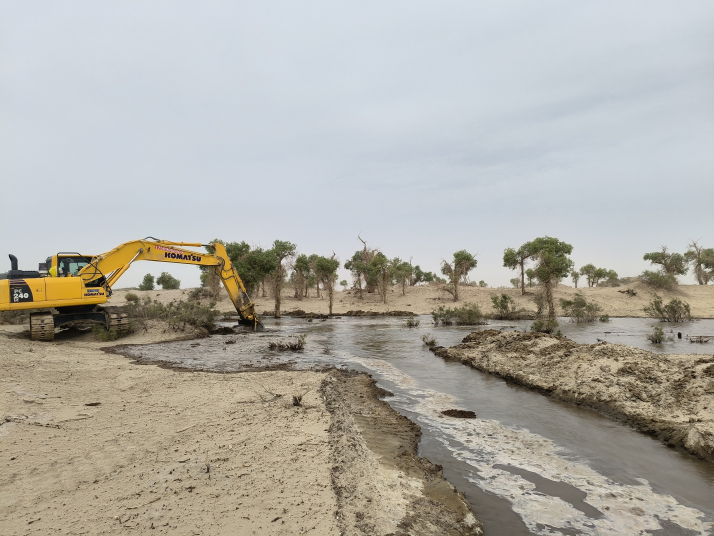 An excavator digs a floodwater irrigation canal in Ruoqiang County in August 2025 (COURTESY PHOTO)
The son In 1997, Aimaier made a decision that surprised many around him. He left a job in tourism and joined the forestry sector. His first posting was the Yingsu Protection Station, which sat in a desolate world of wind and sand nearly 200 km from the county seat. There were no paved roads, no reliable transportation and none of the comforts of modern life. Patrolling meant cycling across rough desert terrain, often alone. Sandstorms were a constant presence. "There were years when it felt like the wind never stopped," Aimaier recalled. The difficulties extended far beyond the job itself. Buying basic supplies required a nearly 70-km round trip by bicycle. Sharp stones punctured tires so frequently that repairing flats became second nature to every ranger stationed there. Yet despite the grueling hardships, he stayed. He stayed—partly out of a profound sense of duty, partly because of his father's legacy, and partly because, against all expectations, he had fallen in love. The woman he loved lived back in the county seat. In an era before smartphones, and with even basic telephone lines frequently down, letters were all they had to carry their love across the desert expanse. For over a year, months would pass between their brief visits. Eventually, they married. Yet, the distance remained—and so did his work. For Usman, watching his son become a forest ranger was one of the proudest moments of his life. The heavy responsibility he had carried for decades was no longer his alone. In 2019, Usman passed away after a prolonged illness. Near the very end, he held his son's hand, leaving him with one final, enduring request. "Plant more trees," he said. "That is how we protect our home." Those parting words became Aimaier's guiding light and inspired more of his family to rally behind the cause. Soon, his younger brother took up the call to protect the woods. Then came his daughter, carrying the torch into the future. The daughter In 2024, Nabire passed the examination to become a forest ranger. She was assigned to the Yiganbujima Protection Station, deep in the desert. But her mother stood firmly against her choice. As a child, Nabire had struggled with health problems. Years earlier, she had suffered a medical emergency while traveling home by train after treatment in Urumqi. For a time, her life hung in the balance. The experience left her mother fearful of seeing her work in such a remote place. Her father, however, saw it differently. He believes that the harshest environments had a way of forging the strongest characters. Nabire agrees. She had grown up listening to the legends of her grandfather and watching her father devote his life to halting the encroaching sands. The profession never seemed unusual to her. It felt like part of the family. On the day she reported for duty, her parents drove her to the station. For a week, Aimaier taught her everything he knew: how to identify plants, how to patrol the landscape, and how to recognize signs of wildlife activity. Then it was time to leave. Unable to hold back her emotions, Nabire burst into tears. Her father tried to sound stern. "You'll get used to it," he said. Only with the passage of time did she fully comprehend the sorrow her father had so carefully concealed from her. With the passing of the seasons, the harsh reality of her duties transformed into a genuine passion. She found comfort in the silence of the desert. She enjoyed watching the sunrise spread across the horizon and the stars emerge above the darkness. Most of all, she loved the wildlife. The first time she saw a goitered gazelle up close, she was astonished. How could such a delicate creature survive in a place so harsh? The question deepened her commitment to protecting the ecosystem around her. One day in early 2025, Nabire and a colleague discovered a gazelle that had been struck and killed by a vehicle near the highway. The sight of the lifeless animal left her heartbroken. That night, she lay awake for hours. Protecting nature, she finally realized, means protecting every fragile life that depends on the desert for survival. Tree planting is her favorite part of the job. "There is something special about watching a tree grow in the desert," she said. "It feels like watching hope take root." Within a year of taking up the post, her dedication earned Nabire a promotion to a supervisory role. Not long afterward, she became engaged. To her father, both milestones felt equally meaningful. His daughter had found not only a career, but also a future. The green line The landscape surrounding Ruoqiang is changing. Large-scale ecological restoration projects have brought water back to parts of the lower Tarim River Basin. Seasonal floodwaters are now redirected through canals and ecological infrastructure designed to nourish forests and desert-edge ecosystems. Aimaier has become one of the key people responsible for managing that process. When seasonal floods arrive, he helps channel the torrents toward the areas where parched vegetation needs them most. What was once feared as a destructive force has been transformed into a powerful tool for ecological restoration. Young poplars are returning. Native vegetation is expanding. Wildlife is reclaiming habitat. The ecological buffer separating the Taklimakan and Kumtag deserts is growing wider. For policymakers, these changes may be measured in hectares of restored land and rising water tables. For Aimaier, it is far more intimate: a healthy sapling, a patch of green surviving another season and water reaching a place where it never reached before. One recent morning, after inspecting newly irrigated vegetation, he stopped and looked toward the distant sand dunes. The deserts that once seemed destined to converge appeared farther apart now. Above him stretched a clear blue sky. He smiled and adjusted the shovel on his shoulder. Then he continued walking along the canal. Behind him lay the land his father had spent a lifetime protecting. Ahead was the future his daughter would help shape. The authors are reporters with the Bayingolin Mongolian Autonomous Prefecture Media Center Comments to zhangshsh@cicgamericas.com |
|
||
|
||||||||||||||||||||||||||||
|