
|
| Xinjiang Today |
| Hetian charts high-quality growth path | |
|
|
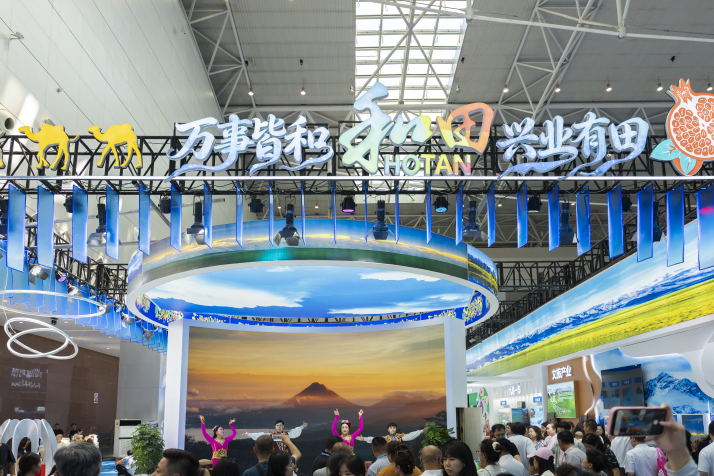 The exhibition area of Hetian (Hotan) Prefecture at the Ninth China-Eurasia Expo in Urumqi on June 27 (VCG)
Xinjiang's development must be planned and advanced as an integrated whole, with south Xinjiang serving as a strategic fulcrum. The region's broader development strategy hinges on tapping the full potential of this key area.
Situated on the southern edge of the Taklimakan Desert and along the northern foothills of the Kunlun Mountains, Hetian (Hotan) Prefecture is a strategic anchor in south Xinjiang, an important hub on the southern route of the Silk Road and a key driver of regional development. "Since the start of the 14th Five-Year Plan period (2021-25), Hetian has implemented the Party's strategy for governing Xinjiang in the new era, pursued high-quality development with a strong focus on improving people's wellbeing, and made significant gains in overall strength. The prefecture has entered the strongest, fastest and most stable period of development in its history," Mahmut Umarjan, Commissioner of the Hetian Prefectural Administrative Office, said at a press conference hosted by the Information Office of the People's Government of Xinjiang Uygur Autonomous Region on May 21. Reflecting on Hetian's achievements over the past five years, he said 2026, the opening year of the 15th Five-Year Plan period (2026-30), marks the beginning of a new journey toward modernization. 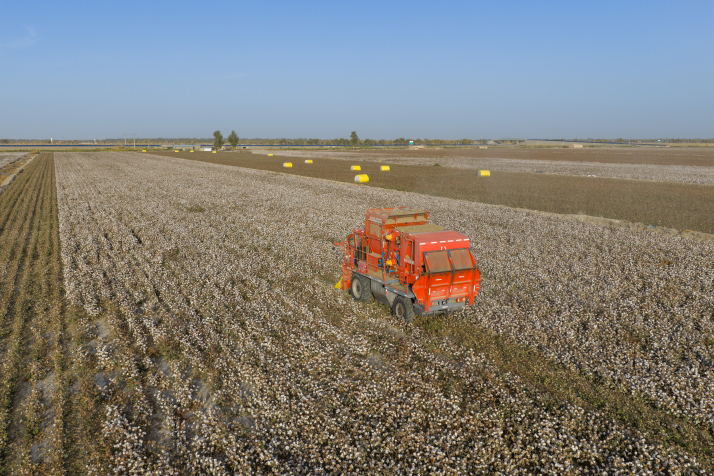 A harvester works in a cotton field in Hetian Prefecture on October 12, 2025 (VCG)
Robust development performance Hetian's GDP grew from 42.663 billion yuan ($6 billion) in 2020 to 64.81 billion yuan ($9.2 billion) in 2025, with an average annual growth of 6 percent. Per-capita GDP increased by nearly 10,000 yuan ($1,428) during the 14th Five-Year Plan period, while per-capita disposable income reached 20,964 yuan ($2,994) last year. The value added of major industrial enterprises, or those with an annual main business revenue of at least 20 million yuan ($2.8 million), totaled 19.05 billion yuan ($2.7 billion) during the 2021-25 period, growing by an average of 23 percent annually. Fixed assets investment over the five-year span amounted to 260 billion yuan ($37.1 billion), with an average annual growth of 8 percent. Over the same five years, general public budget revenue rose by an average of 15 percent annually, while total foreign trade expanded at an average annual rate of 26.4 percent. At the press conference, Mahmut summarized Hetian's achievements during the 14th Five-Year Plan period in four areas: industrial transformation, urban and rural infrastructure, public wellbeing and ecological conservation. He said Hetian's grain output rose for five consecutive years from 2021 to 2025, allowing the prefecture to achieve grain self-sufficiency for the first time. The secondary industry also surpassed the primary industry in its share of the local economy for the first time during the same period, marking a shift from traditional agriculture toward modern industry. Hetian also made major strides in infrastructure development. The Hetian-Ruoqiang Railway, the Wanfang Airport and the Minfeng-Luopu (Lop) first-class highway have been put into operation. The Yurungkash River water conservancy project is progressing steadily. Installed new-energy capacity has exceeded 7 million kilowatts, the 750-kilovolt power transmission loop around the Tarim Basin has been fully connected and 5G networks now cover urban areas, townships and villages. More than 75 percent of fiscal expenditure, totaling over 180 billion yuan ($25.7 billion) was directed toward improving people's livelihoods. Hetian, home to one third of Xinjiang's population lifted out of poverty, has prevented any large-scale return to poverty. Education, healthcare, employment and social security have also developed rapidly. Hetian has integrated ecological restoration with desert-based industries, restoring more than 400,000 hectares of desertified land and effectively curbing desertification during the 14th Five-Year Plan period. The prefecture has planted 49,300 hectares of traditional Chinese medicinal herbs, including cistanche, snake gourd and roses, generating more than 700 million yuan ($100 million) in output value in 2025, while providing stable jobs for 13,000 local residents. These efforts have delivered both environmental and economic benefits. 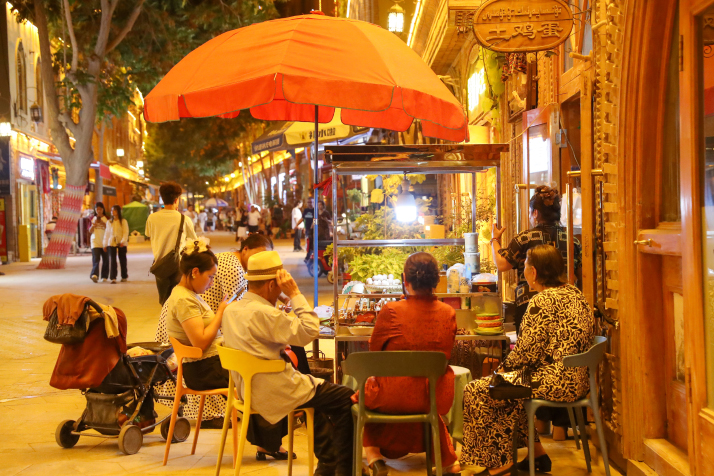 Locals and tourists visit shops and sightsee in Hetian City, capital of Hetian Prefecture, on June 29 (VCG)
Setting the course ahead In April 2026, Hetian released the outline of its 15th Five-Year Plan for economic and social development. The blueprint's goals and tasks are closely aligned with national strategies, Xinjiang's overall development framework and Hetian's resource advantages. From 2026 to 2030, the prefecture aims to achieve an average annual GDP growth of 6 percent and increase per-capita disposable income for both urban and rural residents by more than 6 percent annually. Hetian will continue to extend the green mining industrial chain, expand modern agriculture including traditional Chinese medicinal herbs, specialty fruit cultivation and forestry, improve the business environment and vigorously develop emerging sectors such as new energy, the digital economy, cultural tourism, trade and commerce. The goal is to build a diversified modern industrial system. When it comes to infrastructure, the prefecture will further improve its integrated transportation network, modernize water conservancy, power and digital facilities, and strengthen the foundations for high-quality local development. Zhang Hui, Executive Deputy Commissioner of the Hetian Prefectural Administrative Office, said at the same press conference that the prefecture will uphold a people-centered development philosophy during the 15th Five-Year Plan period. Hetian will continue to allocate more than 70 percent of fiscal expenditure to livelihood sectors, ensuring that people of all ethnic groups fully share in the benefits of development. Consolidating poverty alleviation gains Compared with most of Xinjiang, Hetian still has a relatively weak economic base. During the 15th Five-Year Plan period, consolidating and expanding poverty alleviation gains while advancing rural revitalization will remain one of the prefecture's key priorities. Hetian will begin by strengthening targeted monitoring. The prefecture will continue improving its regular tracking and assistance mechanism by identifying rural households at risk of falling into poverty, detecting risks early and providing timely support to firmly guard against any large-scale relapse to destitution. Hetian will drive rural development through industrial growth. Eligible households will be encouraged to develop crop and livestock farming, Gobi Desert facility agriculture and courtyard economies. The prefecture will also strengthen the deep processing of agricultural productions, improve household incentive and subsidy policies, and refine mechanisms that link enterprises with farmers to ensure the latter share the benefits of industrial development. These measures will help rural households participate in more stages of the industrial chain, build confidence in development and increase incomes. Additionally, Hetian will boost local incomes through employment support. The prefecture has made employment a top priority, tapping the job-creation potential of sectors such as textiles and garments, services and emerging business models, while promoting outbound employment among its residents. The aim is to ensure that everyone who is able and willing to work can find a job and earn a stable income. Zhang cited Hetian-style barbecue as an example, saying it is becoming a distinctive calling card for the prefecture. Many people from Hetian have opened restaurants in other parts of China, bringing Hetian-style barbecue to major cities such as Guangzhou, Changsha and Wuhan. One entrepreneur from Hetian has opened 57 barbecue restaurants in 10 cities outside Xinjiang, helping more than 1,200 people from his hometown find jobs elsewhere and becoming a well-known local example of entrepreneurship-driven prosperity. "Going forward, we will continue to step up our employment efforts so that every pair of hardworking hands has work to do, and every steady step can lead to prosperity," Zhang said. Ecological and economic gains Hetian's fragile ecological environment poses another major challenge. Long plagued by sandstorms and desert encroachment, the prefecture aims to bring more than 400,000 hectares of land under desertification control during the 15th Five-Year Plan period, while expanding its desert-based specialty industries to more than 66,000 hectares. While continuing to plant trees to curb desertification and strengthen its ecological security barrier, Hetian is also exploring ways to turn sandy land into a source of income. Mahmut offered the example of a college graduate in Yutian County who, after returning to her hometown, leased 200 hectares of sandy land with her family for rose cultivation. She subsequently led local farmers in establishing a cooperative, developed more than 10 rose-related products, and generated daily sales exceeding 5,000 yuan ($710) through online and offline channels. "Desert roses are not only drought-resistant but also incredibly resilient," Mahmut quoted the entrepreneur as saying. "People in Hetian are the same. Even in the harshest environment, we still bloom into the most beautiful flowers." "This is a snapshot of Hetian's story of combating desertification. It also shows that the deep-rooted resilience of Hetian's people is becoming their greatest weapon in the fight against wind and sand," Mahmut said. He noted that Hetian's opportunities will outweigh its challenges during the 15th Five-Year Plan period. "As long as we address our own challenges and seize development opportunities, we can achieve remarkable progress," Mahmut concluded. Comments to liangxiao@cicgamericas.com |
|
||||||||||||||||||||||||||||
|