
|
| Xinjiang Today |
| A poet etched in history | |
|
|
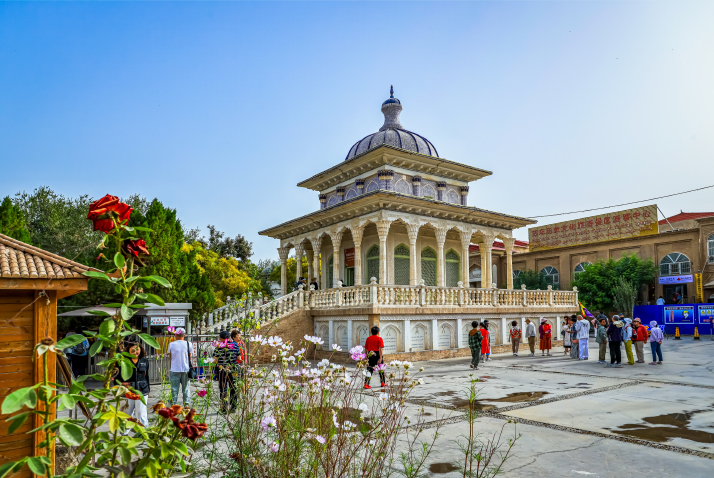 The Memorial Mausoleum of Amannisa Khan in Shache, Kashi Prefecture, on September 8, 2025 (VCG)
In Shache County, Kashi (Kashgar) Prefecture, stands the Memorial Mausoleum of Amannisa Khan, erected to honor the 16th-century Uygur poet who compiled and systematized the Twelve Muqams, a canon of classical Uygur music. With the melodies from these Muqams carved into its towering inner walls, the mausoleum serves not only as a monument to her legacy, but also as a vibrant center for learning about Uygur musical culture.
Muqam is a distinctive genre of Uygur performance, which includes the Twelve Muqams, Dolan Muqam, Hami Muqam and other subgenres. Performed everywhere from large cities to small villages throughout Xinjiang, Muqams combine singing, dancing and instrumental music into a joyful feast of art. Referred to as the Pearl of the Silk Road, the Twelve Muqams stands as the pinnacle of the genre. Its survival through the ages is an invaluable artistic legacy left to humanity by Amannisa in her short lifetime. Born in poverty, blessed by destiny In 1526, Amannisa was born into the family of a hardworking but poor woodcutter in the oasis of Shache, at that time part of the Yarkand Khanate. Founded by descendants of the Mongolian Chagatai lineage in 1514, this Islamic state covered most of present-day Xinjiang and parts of Central Asia, where Persian literature, Central Asian melodies, art from China's Central Plains and indigenous Uygur traditions intermingled and inspired one another. Culture flowed throughout the oasis like underground spring water. Though very poor, Amannisa's father Mahmut loved music and poetry. After a day's toil, he would pluck the tambur, a long-necked lute, and sing folk ballads. Young Amannisa grew up surrounded by her father's music. Gifted with a natural artistic talent, she excelled at singing, dancing, verse and prose alike. The gurgling Yarkand River, desert winds and the cries of vendors in the bazaar formed her earliest artistic education. Amannisa's fate shifted when she turned 13. According to Biographies of Musicians, a Qing Dynasty (1644-1911) text, in 1539, Abdurashid Khan, the second ruler of the Yarkand Khanate, traveled incognito. Passing a ramshackle earthen house one evening at dusk, he heard a tambur melody floating out, intertwined with a young girl's clear, pure voice: My life is a candle flame, flickering in the wind; My love is the bright moon, veiled by dark clouds. Oh Allah, grant me wisdom and strength, That I may bloom like a flower amid the desert sands. Stirred by the soulful singing, the khan pushed open the door and beheld a bright-eyed young girl dressed in simple rags. He was astounded to learn she had composed the poem herself. He tested her knowledge on the spot, questioning her on poetic meter and music theory, to which she answered fluently without hesitation. What moved him most deeply was an impromptu piece she composed titled Dedication of the Heart, expressing her devotion to Allah, a thirst for knowledge and compassion for ordinary people. This fateful encounter altered both their lives. Soon after, Amannisa married the khan and was thereafter revered as Amannisa Khan. This was no simple Cinderella tale—the khan already had numerous consorts, and court politics were fraught with intrigue. Yet with extraordinary wisdom and artistic prowess, Amannisa won not only the khan's affection but also a unique standing to participate in the khanate's cultural undertakings. 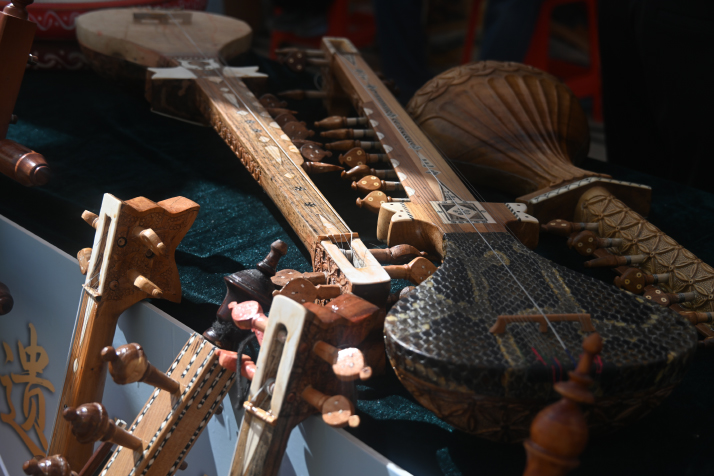 Traditional Uygur musical instruments on display in Hami on June 13 (VCG)
Compiling the Twelve Muqams Amannisa's greatest contribution after entering the royal family was leading and personally undertaking the systematic collection, editing and codification of the Twelve Muqams, the essence of classical Uygur music. Back then, Muqam pieces were scattered among the people and on the verge of extinction, and many contained vulgar, indecent content. At Amannisa's suggestion, the khan summoned musicians and poets from across the realm to preserve this cultural heritage. Amannisa emerged as the true driving force behind the project, dividing her work into three core tasks. First, collection and collation: She dispatched musicians to every corner of the khanate to record performances by elderly folk artists. From Kashi to Hetian (Hotan), Kuche (Kucha or Kuqa) to Tulufan (Turpan), hundreds of regional variants were documented. Second, refinement and purification: She boldly cut superstitious, lewd and crude verses from the original texts, replacing them with elegant poetry. She penned countless new lyrics herself, covering praise for Allah, faithful love, pursuit of justice and reflections on nature. Her verses used fresh, unadorned language, a stark contrast to the overornate style of Persian poetry prevalent at the time. Third, systematic standardization: Collaborating with Yusuf Qadir Khan, the chief court musician, she standardized Muqam into 12 complete suites, each structured in three parts—Naghma (melody), Dastan (narrative) and Meshrep (singing, dancing and performances)—establishing a fully formed musical framework. Remarkably, in the deeply patriarchal Islamic society of the 16th century, Amannisa strove to preserve a feminine perspective within the Muqam. Many lyrics she authored tenderly capture women's genuine experiences of love, marriage and faith—a revolutionary breakthrough for her era. One of her poems reads: I am a grain of sand upon Yarkand's banks, Written into verse by Allah's own hand. If you seek the secret of my mortal life, Search for it within the Twelve Muqams. Biographies of Musicians comments on the Twelve Muqams: "From kings to the poor, saints to unbelievers—all find delight and solace within this musical form." A shooting star gone too soon A brilliant shooting star that streaked briefly across the night sky, Amannisa passed away in 1560, at just 34, due to complications from childbirth. Her death devastated the khan. According to records, he neglected state affairs for months and ordered a period of national mourning. From a cultural perspective, Amannisa stands as a pivotal guardian of civilization. Against a backdrop of political unrest and fragile cultural inheritance across Central Asia in the 16th century, her systematic restoration of the Muqam amounted to a heroic cultural rescue mission. Without her labors, much of classical Uygur musical heritage would likely have been lost forever. She elevated oral folk art into a canonical, structured tradition, bridging the gap between folk simplicity and refined artistry while retaining the vitality of grassroots culture. From a feminist perspective, she defied the rigid limitations of her age. In an Islamic society where women were confined to private domestic life and excluded from public artistic creation, she not only stepped into the heart of cultural production as a woman but reshaped its core content through a female worldview. She proved women were far more than passive subjects depicted in art—they could be authors of history. Though her position as royal consort opened doors, her lasting legacy stems chiefly from her unmatched talent and unyielding resolve. History holds countless royal consorts, yet only one Amannisa. Today, the melodies of the Twelve Muqams ring out in Kashi's old town, in theaters across Urumqi and on stages around the world. As Uygur vocalists sing verses penned by her hand, Amannisa feels eternally present. Her life blazed as fleetingly as fireworks, yet illuminated five centuries of cultural heritage. This great woman from the banks of the Yarkand River lived true to her own poetic words: If my songs form a ladder connecting heaven and earth, I shall gladly be its humblest rung. When future generations climb through me toward light, That shall be the secret smile I keep beneath the earth. 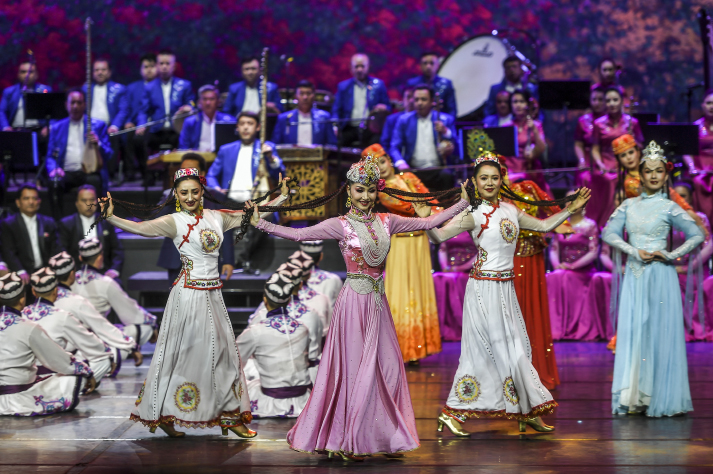 Dancers perform in Muqam Masterpiece: Chebiyat at the Muqam Art Troupe Auditorium of the Xinjiang Art Theater in Urumqi on April 7, 2025 (CNSPHOTO)
The enduring value In 2005, UNESCO inscribed the Uygur Muqam of Xinjiang to its Intangible Cultural Heritage list, affirming its status as a shared treasure of humanity. A grand classical suite weaving song, dance and instrumental performance into one, the Twelve Muqams flows like a river of history, carrying the joys, sorrows and life wisdom of the Uygur people spanning thousands of years. Every melody holds the sincere emotions of oasis dwellers; every line of verse glimmers with literary brilliance from masters such as the 15th-century poet Alisher Navoi. More than an encyclopedia of Uygur culture, it is a radiant gem in the treasure trove of Chinese national arts. Its lyrics draw from philosophical proverbs, scholarly poetry and folk sayings, paired with rich, diverse musical forms that vividly embody the diversity and inclusiveness of Chinese civilization. Its significance extends far beyond music itself. In the 1950s, a dedicated group of veteran musicians undertook the arduous rescue of the Twelve Muqams. Utilizing wire recordings and precise notation, they permanently secured this fragile oral tradition as a written legacy. Today, supported by government and public efforts, a complete inheritance system and formal academic education have been established. Digital technology and innovative theatrical adaptations have also carried this art onto stages around the world. Some of the melodies within the Twelve Muqams are over a thousand years old, and today they continue to echo along the Silk Road and beyond. They serve as a cultural bond fostering a stronger sense of community for the Chinese nation and facilitate cultural exchange between the East and West. Protecting and passing down this heritage means safeguarding a shared spiritual home for all China's ethnic groups, allowing the ancient echoes of the Silk Road to continue inspiring hearts in the new era. Comments to lanxinzhen@cicgamericas.com |
|
||||||||||||||||||||||||||||
|