
|
| Xinjiang Today |
| Rural revitalization seen through travel | |
|
|
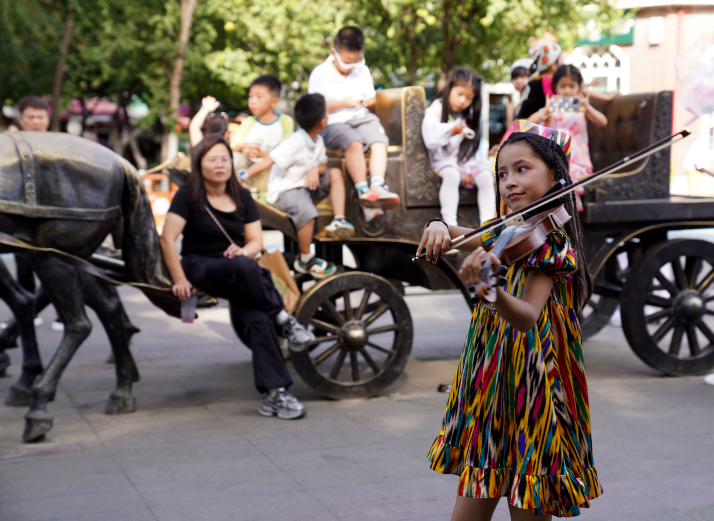 A Uygur girl plays for tourists at Liuxing Street in Yining on August 4, 2025 (XINHUA)
As I wandered through the rolling expanse of the Kalajun Grassland, part of the Tianshan Mountains, a UNESCO World Heritage site, in Xinjiang, I was spellbound by the endless waves of green stretching beneath a dome of piercing blue sky, rimmed by distant snow-capped peaks. Then, from behind me, a burst of familiar language cut through the breeze: Indonesian. I turned, surprised and instinctively replied in my mother tongue. Laughter followed. They were backpackers from Jakarta, their faces lit with the thrill of finally setting foot in Xinjiang, a place they had long dreamed about.
Such encounters no longer feel rare. In recent years, Xinjiang has become an unlikely travel magnet for Indonesians. From Instagram reels to TikTok guides, Indonesian social media platforms are abuzz with tips, tales and vivid snapshots of this remote corner of China. But nothing truly compares to being there. For travelers like me, Xinjiang isn't just a destination; it's a revelation best lived and shared.  Hendy Yuniarto and his colleagues from Beijing Foreign Studies University visit the Sayram Lake in Bortala Mongolian Autonomous Prefecture on August 26, 2025 (COURTESY PHOTO)
Reasons for revisiting Xinjiang Xinjiang's sweeping natural beauty, cultural diversity, deep-rooted heritage, distinctive cuisine and steadily improving infrastructure are only part of its allure. What truly sets it apart and why I so often recommend it to friends and family is the way tourism has become a catalyst for rural revitalization. My own journey with Xinjiang began four years ago, through a chance opportunity that introduced me to its ethnic cultures, poverty alleviation efforts and long-term development strategies. Those early encounters left a mark that has never faded. In 2025, I returned with new destinations in mind: Bortala Mongolian Autonomous Prefecture and Yili (Ili) Kazak Autonomous Prefecture. What I encountered there was more than just scenery—it was a living landscape shaped by people transforming natural resources into experiences, and experiences into thriving livelihoods. It reminded me powerfully of rural Indonesia, where tourism has uplifted local crafts and agriculture, allowing villages to grow without losing their cultural roots. Xinjiang's model feels like a mirror held up to our own aspirations. One stop in Bole, a city near the China-Kazakhstan border, particularly stood out. Home to a large Mongolian population, the city has become a hub for traditional ger production. At a local production facility, I watched craftspeople assemble gers, round, portable tents emblematic of nomadic life, and decorate them with artistic precision. Demand has soared as gers are increasingly used as unique tourist accommodation and as cultural venues, sparking job creation and income growth. I also visited a family-run dairy workshop and a winery nestled in local vineyards, each turning raw regional resources into high-value products. Seeing a ger's wooden lattice and felt cover brought to mind Java's Joglo and Pendopo houses, which share similar features: ventilation, adaptability and deep cultural roots. The studio's "hands-on" lessons echoed the batik workshops in Yogyakarta, a historic Indonesian city. In both regions, tradition is not just preserved—it is practiced, adapted and passed on. 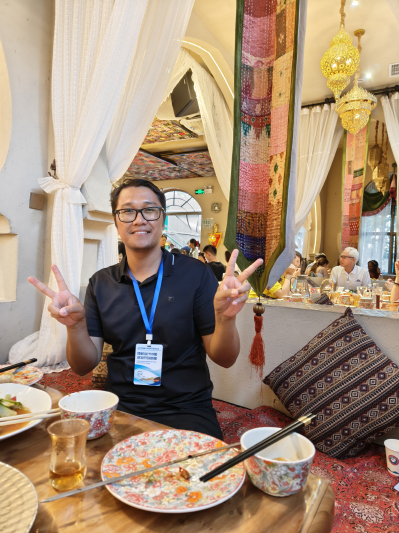 Hendy Yuniarto enjoys the local Xinjiang food at a restaurant in Yining on August 27, 2025 (COURTESY PHOTO)
Villages, springs and blue horizons Leaving Bole, we drove west for about an hour toward Wenquan County, heading for Bogedaer Village, a place that has quietly reinvented itself through tourism-driven rural revitalization. The smooth expressways and neatly maintained roads we traveled offered more than comfort; they were evidence of how Xinjiang's expanding infrastructure is knitting once-remote communities into an accessible network of destinations. A compact, watchtower-like structure about three stories high stood at the village entrance, signaling arrival. Alongside the road, homes made of brick and packed earth were adorned with vibrant murals illustrating local folklore and ethnic traditions. Courtyards burst with vegetables and blossoms, lovingly cared for by residents. Tourists wandered at a relaxed pace, drawn into the village's tranquil rhythm. From time to time, the lilting sound of a dutar, a string instrument, floated through the air as Uygur children performed folk dances nearby. Bogedaer offers more than pastoral charm. Visitors can try Mongolian archery, ride horses across open fields, or savor distinctive regional dishes. Guesthouses converted from traditional homes and gers pitched under wide skies provide immersive lodging. At a nearby workshop, I watched artisans handcraft Mongolian garments, richly patterned, warm and deeply rooted in local identity. Here, culture isn't locked behind glass; it lives, works and earns. Wenquan, which means hot spring literally, is named for its thermal water resources. At a popular open-air hot spring area, I soaked in its mineral-rich pools. Later, I visited a white salmon breeding center, where the fish, in both fresh and processed forms, has become a prized culinary souvenir for visitors, adding yet another layer to the region's evolving rural economy. Roughly two and a half hours away, the Sayram Lake revealed itself like a vast, high-altitude mirror. At 2,071 meters above sea level, it's Xinjiang's largest alpine lake. Its clarity and color stunned me, deep blue water framed by snow-draped peaks, swans gliding silently past. The scene stirred a familiar ache. The Sayram Lake reminded me of Indonesia's Lake Toba: two lakes, two worlds, yet both forging harmony between nature, community and journey. They turn distant places into reachable ones and fleeting visits into lasting memories. Grasslands, flavors and a living mosaic My journey next led me to the Kalajun Grassland, a three-hour drive from Yining, where I had stayed for several days. The Kalajun Grassland opens onto a boundless canvas of emerald pastures. Herds of sleek horses roamed freely across the steppe, framed by snow-capped mountains that rise in the distance with breathtaking majesty. Tourists stopped frequently to pose for photos, while others immersed themselves more deeply—practicing archery, galloping on horseback, or simply lying in the grass and watching clouds drift lazily overhead. It was here I met two Kazak girls who warmly invited me to join them in making a traditional cheese from fermented milk. The process was humble and hands-on: kneading curds into small balls and allowing them to air-dry in the open. As we worked, I thought of dadih, a fermented water buffalo milk delicacy from West Sumatra, Indonesia, traditionally prepared in bamboo. Despite differences in setting, technique and taste, both traditions embody the same local ingenuity, adapting what nature offers into nourishment and memory. That evening, back in Yining, I returned to a favorite ritual: walking to Liuxing Street and indulging in Xinjiang lamb skewers. No trip here feels complete without them. Grilled over open flames, simply but perfectly seasoned, they remain my top recommendation for any Indonesian visitor. While we have our own sate (Indonesian satay) back home, Xinjiang's lamb skewers pack a boldness that lingers. Liuxing Street, too, lingers in the mind. Built in 1935 by a German engineer, the hexagonal neighborhood radiates outward like a compass, its six main roads dividing the district into fan-shaped sections. Designed as a self-contained community, it blends Eastern and Western influences, with schools, mosques, Orthodox churches and homes all nestled together. Today, residents from eight ethnic groups live here, forming a vibrant cross-section of Xinjiang's cultural tapestry. At night, Liuxing Street transforms. Music and dance animate the air, performers gather crowds, and the scent of grilled meats and sweet pastries beckons. Sampling Russian bread and creamy ice cream, I watched life unfold, unhurried, diverse and welcoming. A place where heritage and hospitality are never far apart. Looking ahead together Unless one sees it firsthand, it's hard to grasp just how advanced Xinjiang's infrastructure has become. In cities like Bole, I encountered modern highways, efficient public transit, contemporary housing, well-equipped hospitals and familiar global brands. These are no longer exceptions; they are part of daily life, enhancing both convenience and quality of living across the region. Agriculture, too, has been transformed. Despite the arid climate and reliance on irrigation, the widespread use of smart equipment, automation and Internet of Things technologies has made farming more efficient and sustainable. Today, Xinjiang is a major producer of high-quality fruits and food products, many processed locally into goods that reach far beyond regional borders. But Xinjiang offers more than natural beauty or economic progress. My two visits have deepened my appreciation for how modernization and tradition can coexist. Supported by infrastructure, innovation and the energy of local communities, people here are reshaping their lives—through farming, crafts, tourism and the arts, without losing cultural roots. Milk becomes cheese and yogurt, grapes turn to wine, and folk dances find new life on modern stages. What ties it all together is the determination, creativity and warmth of Xinjiang's people. In Indonesia, we call this spirit gotong royong, mutual cooperation for shared prosperity. It is this common ideal that allows people to recognize and learn from one another. As travel grows easier and stories travel farther, I hope to continue sharing Xinjiang's voice with Indonesian audiences and bringing Indonesia's voice to Xinjiang. In doing so, we build more than bridges. We build understanding. The author is an Indonesian teacher at the School of Asian Studies of Beijing Foreign Studies University Comments to zhaowei@cicgamericas.com |
|
||||||||||||||||||||||||||||
|