|
| Xinjiang Today |
| A crucial corridor | |
|
|
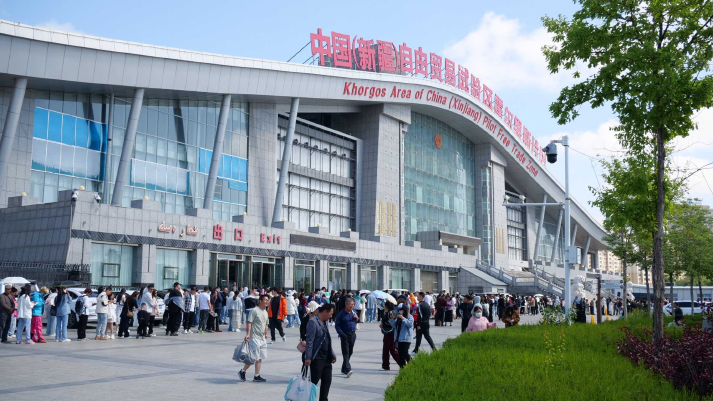 The Huoerguosi Area of the China (Xinjiang) Pilot Free Trade Zone on May 2, 2025 (XINHUA)
In the predawn darkness of a late-2025 morning, a special freight train hurtled through the Huoerguosi (Khorgas or Horgos) land port in Yili (Ili) Kazak Autonomous Prefecture of Xinjiang, a crucial checkpoint on the border between China and Kazakhstan. Its cargo was not the usual containers of electronics or apparel, but something far more extraordinary: wind turbine blades, each stretching an astonishing 80 meters, longer than an Olympic swimming pool. This "wind blade train," bound for a renewable energy project in Central Asia, symbolized a new era for Xinjiang, the region it was departing from. Just a few years ago, this same land port handled mostly regional goods. Now, it hums with the activity of a global logistics hub, processing everything from fresh fruit and honey to the most advanced made-in-China electric vehicles. The place is the most visible pulse point of an economic transformation so rapid that it has redrawn the landscape of Eurasian trade. Driven by the national strategy to open westward, Xinjiang, once a landlocked frontier, is now China's fastest-growing trade gateway. The region's foreign trade crossed 520 billion yuan ($75 billion) in 2025, up 19.9 percent year on year, surpassing the 500-billion-yuan ($72 billion) threshold for the first time, Urumqi Customs announced in January. The growth rate ranked first nationwide. The autonomous region has established trade ties with 228 countries and regions. This has cemented its role from a transit route to a dynamic commercial nucleus at the heart of the Belt and Road Initiative (BRI).
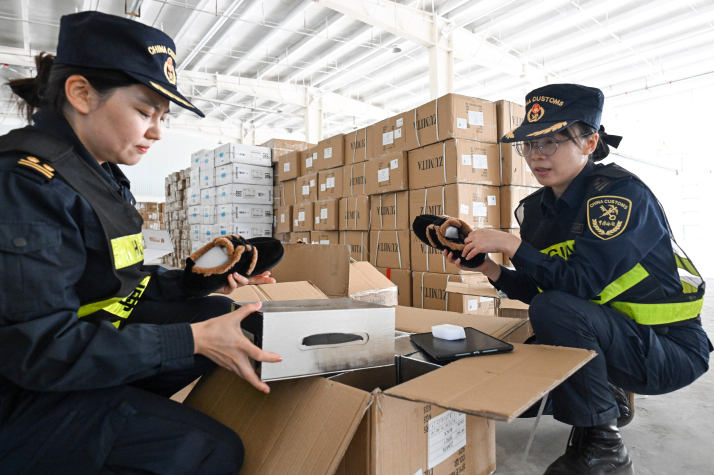
Customs officers inspect a shipment of shoes bound for Kazakhstan at the Baketu (Baktu) Port in Tacheng Prefecture on September 17, 2025 (XINHUA) Delivering complete packages The story of this transformation is told by the changing nature of the goods in transit. Qian Yanni, a customs agent for Xinjiang Feichi International Freight Forward Co. Ltd., has witnessed the development of one of its fastest-growing segments: renewable energy. "For countries in Central Asia, Chinese companies are delivering not just equipment, but a complete package—advanced green technology, mature infrastructure experience and a reliable industrial chain," Qian told People's Daily. Her company, which began specializing in exporting wind farm components in 2016, now operates a dedicated fleet of over 100 specialty vehicles to meet the demand that has expanded from Kazakhstan to Uzbekistan and Azerbaijan. The market's rapid growth has drawn competitors, but Qian sees their arrival as validation. "The pie is getting bigger," she said. Her firm has already secured new contracts for 2026, expected to surpass 2025's figures. "If our own fleet isn't enough, we'll have to rent more trucks." Xinjiang's export structure continued to optimize last year, with mechanical and electrical product exports amounting to 186.5 billion yuan ($26.87 billion), a jump of 40.7 percent. Shipments of automotive parts, electrical equipment and electronic components saw considerable increase, while export of high-end equipment linked to new quality productive forces surged nearly 70 percent. Agricultural exports, including walnuts and grapes, also gained momentum, driving a 25.4-percent increase in the region's total agricultural exports. Xinjiang's deepening trade ties under the BRI were a primary driver of its foreign trade growth. Trade with BRI partner countries amounted to 458.37 billion yuan ($66 billion), an increase of 14.7 percent, according to Urumqi Customs. Trade with the five Central Asian countries alone exceeded 270 billion yuan ($39 billion). The region also accelerated its outreach to ASEAN, Africa, the Middle East and Latin America.
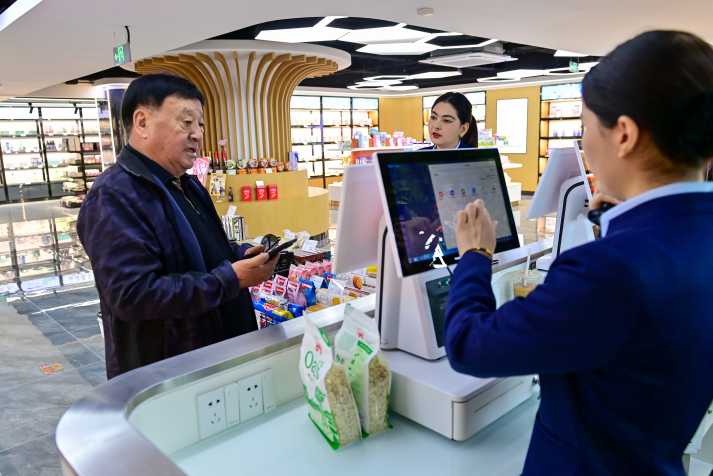
A customer buys imported goods at a bonded imported goods shopping center in Urumqi on November 5, 2024 (XINHUA) Behind the boom This foreign trade boom is the result of a multi-level strategy to build what officials term a "three-dimensional platform for opening up." Huoerguosi is one of three strategic hubs in the China (Xinjiang) Pilot Free Trade Zone (FTZ), established in late 2023 alongside regional capital Urumqi and southern city Kashi (Kashgar). This policy experiment is designed to streamline trade and attract investment through regulatory innovation. In just two years, the pilot FTZ has boosted Xinjiang's foreign trade, turning the region into a key logistics and trade hub, driving high-quality development through high-standard opening up. At a press conference on January 28, Li Xuan, Deputy Director of Xinjiang's Department of Commerce, called the FTZ the spearhead of a broader system supported by economic development zones and cross-border cooperation areas. Infrastructure has been scaled to support the ambition. The Urumqi Tianshan International Airport now operates 37 international cargo routes to 36 cities across 22 countries and regions, with cargo throughput skyrocketing 152.2 percent in 2025. On the ground, major highway ports operate non-stop. As trade volumes surge, local governments and customs authorities across Xinjiang are streamlining business processes and enhancing service efficiency. At the Alashankou (Alataw Pass) railway port in Bortala Mongolian Autonomous Prefecture, large container scanners complete inspections in under five minutes, over 90 percent faster than manual checks. At the Urumqi International Land Port Area, enhanced customs facilitation measures have improved train service efficiency by more than 30 percent and reduced container handling costs. Moreover, customs have pioneered dedicated "green channels" for unconventional cargo like wind blades, slashing clearance time from days to just a day. Appointment-based clearance and intelligent inspection systems have been introduced, enabling smoother and faster border crossings. Li said a fundamental driver behind the improved quality and efficiency of Xinjiang's foreign trade is the concerted optimization of its international business environment. Key measures include new port economy development regulations and a suite of policies designed to spur innovation in goods trade, services and digital commerce. To solidify this foundation, Xinjiang is constructing a comprehensive, multi-tiered service ecosystem. This integrates government bodies, industry associations, professional organizations and enterprises, creating robust institutional support for the growth of market entities. In parallel, the region is proactively undertaking a strategic industrial relocation, drawing manufacturing and export-oriented capacity from east and central China while mounting an all-out effort to attract investment. This push has already borne fruit, with a significant number of export-focused industrial projects either established or slated for launch in Xinjiang. "With the vigorous development of new foreign trade formats such as global bonded aircraft maintenance and cross-border e-commerce, Xinjiang continues to optimize its trade structure, while the integration of industry and trade is strengthening," Li said. Comments to luyan@cicgamericas.com |
|
||||||||||||||||||||||||||||
|