
|
| Xinjiang Today |
| CPPCC members ensure grassroots voices are heard | |
|
|
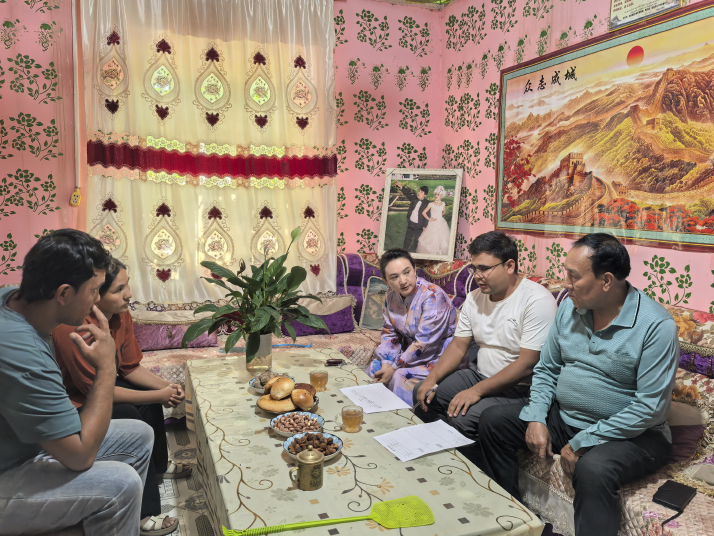 Gulibaiheremu Maimaiti (third right), a member of the CPPCC Xinjiang Uygur Autonomous Regional Committee, visits a farmer's home in Shache County, Kashi (Kashgar) Prefecture. Gulibaiheremu is a senior agronomist at the Shache County Agricultural Technology Promotion Center (COURTESY PHOTO)
The Xinjiang Two Sessions—the Fourth Session of the 14th Xinjiang Uygur Autonomous Regional People's Congress and the Fourth Session of the 13th Xinjiang Uygur Autonomous Regional Committee of the Chinese People's Political Consultative Conference (CPPCC)—which were held in Urumqi last month, were windows into the whole-process people's democracy. A concept introduced in 2019, the whole-process people's democracy ensures public participation throughout the entire process of governance, covering all sectors of society and all aspects of the democratic process. From herders to entrepreneurs, farmers to artists, the concerns of people across Xinjiang's diverse ethnic tapestry have been heard, addressed through formal procedures, and translated into policy blueprints for sustaining social stability and enduring peace. When politics meets the soil Gulibaiheremu Maimaiti, a senior agronomist at the Shache County Agricultural Technology Promotion Center in Kashi (Kashgar) Prefecture, shoulders dual responsibility. As a member of the Xinjiang CPPCC committee, she carries villagers' hopes alongside her agricultural toolkit. "I always bear in mind the responsibility of this dual identity: to use my professional skills to safeguard crop growth, and to fulfill my duty as a political advisor to voice the concerns and suggestions of people at the grassroots," she said. "Every time I go to a greenhouse or a wheat field, people open their hearts, talking to me about the harvest, their ideas and hopes. I take note of all these simple, heartfelt words, incorporate them into my suggestions, and bring them to the annual sessions." CPPCC members are nominated across professions, ethnicities and faiths to ensure no perspective goes unheard. Political advisors use their positions and professional strengths to play exemplary roles in Xinjiang. Members of the CPPCC regional committee who are also entrepreneurs have created jobs for local residents through investment and businesses. Those from technical fields impart skills, train local talent and enhance people's capacity for self-development. Those who are educators are committed to improving local teaching quality and nurturing more outstanding students. Medical professionals work to elevate primary-level healthcare and safeguard public health. Those who are village leaders work at the forefront of rural revitalization, leading communities in developing production and improving livelihoods. The members have become a significant force in advancing Xinjiang's development. "I will continue to walk between fields and sit among the people. As a political advisor from the agriculture sector, I will try to contribute to rural revitalization with both technology and my advisory role," Gulibaiheremu said. 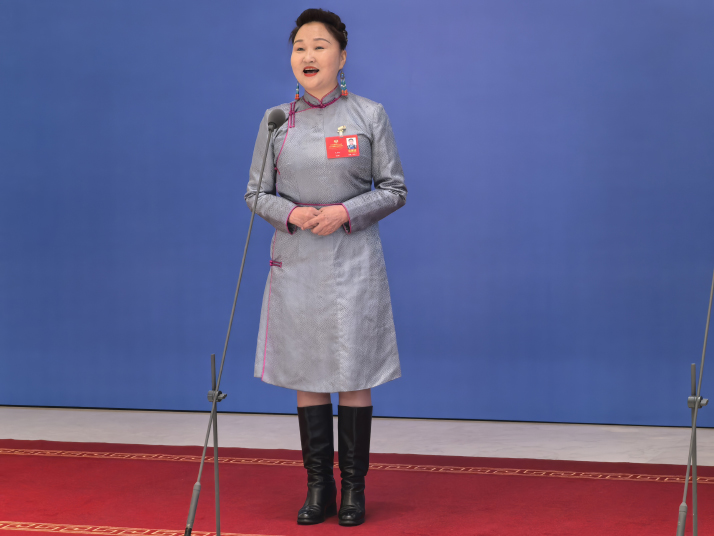 Wuerna, a member of the CPPCC Xinjiang Uygur Autonomous Regional Committee and head of the vocal music team at the Song and Dance Troupe of Bayingolin Mongolian Autonomous Prefecture, fields questions from the media during the Fourth Session of the 13th CPPCC Xinjiang Uygur Autonomous Regional Committee in Urumqi on January 26 (COURTESY PHOTO)
The road to progress Projects like the Urumqi-Yuli Expressway enhance Xinjiang's interconnectedness. Open to traffic in late 2025, the expressway through the Tianshan Mountains that bisect Xinjiang into northern and southern parts, brings the two parts closer. For Wuerna, a member of the regional CPPCC committee and head of the vocal music team at the Song and Dance Troupe of Bayingolin Mongolian Autonomous Prefecture, the highway is a lifeline. In the early 1980s, she traveled from Kuerle in southeastern Xinjiang to Urumqi for a competition. "The roads were gravel then. We had to go around the Tianshan Mountains, navigating nearly 100 km of rugged mountain roads. Kuerle had only one proper road back then. We traveled on horses to perform in villages, often spending half a day on the journey to perform for the other half," she recalled. "Now it's three hours from Kuerle to Urumqi. Driving through the Tianshan Shengli Tunnel, I saw with my own eyes that crossing the Tianshan Mountains in just 20 minutes was not a dream," she said. Thanks to the increasingly convenient transportation, the number of visitors to the scenic areas in Bayingolin is steadily rising. Freshly picked local red dates can reach their markets on the same day, making them more valuable. Recently, a critically ill child from Kuerle was transported swiftly to Urumqi in under three hours to receive emergency treatment. These changes make industries thrive and people more prosperous, Wuerna added. 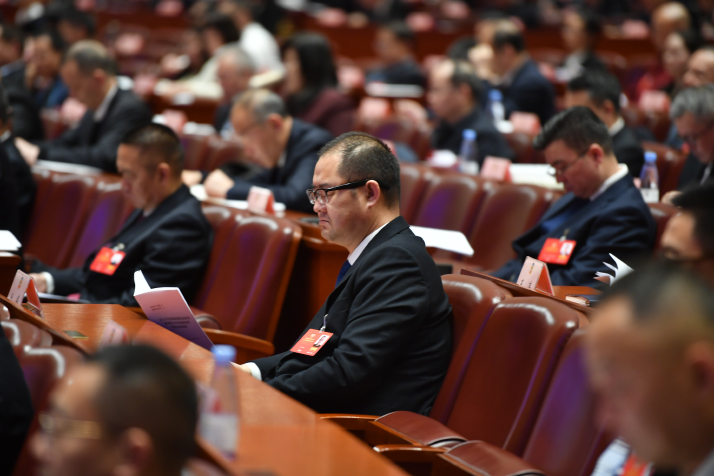 Yue Feng, a member of the CPPCC regional committee and Vice President of the Xinjiang Internet Society, at the opening ceremony of the Fourth Session of the 13th CPPCC Xinjiang Uygur Autonomous Regional Committee in Urumqi on January 26 (COURTESY PHOTO)
A fruitful year The past year was a fruitful one for the regional committee of the CPPCC, in which it held nearly three dozen consultation activities, conducted over 50 inspection tours and research projects, and produced 47 key consultation outcomes. It also received and responded to 1,120 suggestions, and formally accepted and addressed 514. Various special committees organized members to investigate real-world conditions and come up with suggestions for improvement. The committee also supported various political parties, organizations and prominent individuals without party affiliation to express their opinions and play their roles within it. These groups submitted more than 300 suggestions, provided 810 reports on social conditions and public opinion, and gave over 130 speeches at the conference. Their work helped address pressing public concerns, promoting the dissemination of policies, safeguarding public interests and fostering social harmony. Behind these numbers are advisors like Yue Feng, who focus on shaping the future. Yue is Vice President of the Xinjiang Internet Society. As a veteran Internet industry professional, he focuses on healthy development in emerging sectors and promotes democratic supervision. He calls the Internet a crucial front for cultivating morality and passing on culture. One event stands out from his tenure. In 2018, he called for establishing a Xinjiang new media industry association based on the regional Internet landscape at the time. This proposal led to the establishment of the Xinjiang Internet Society in 2021, which fosters sustainable development of the local Internet industry. Last year, he suggested setting up a Xinjiang Internet Development Foundation to mobilize social funds for the industry's sustained growth. This year, he came up with implementation details: fostering a favorable environment for AI use in Xinjiang, promoting further AI application and using AI for cultural enrichment. "I hope that through my efforts I can leverage the Internet to share the stories of Xinjiang well, contributing my part to Xinjiang's development in the new era," Yue said. (Print Edition Title: The Amplifiers) Comments to zhangxinyang@cicgamericas.com |
|
||||||||||||||||||||||||||||
|