|
| Xinjiang Today |
| Greater openness, greater opportunity | |
|
|
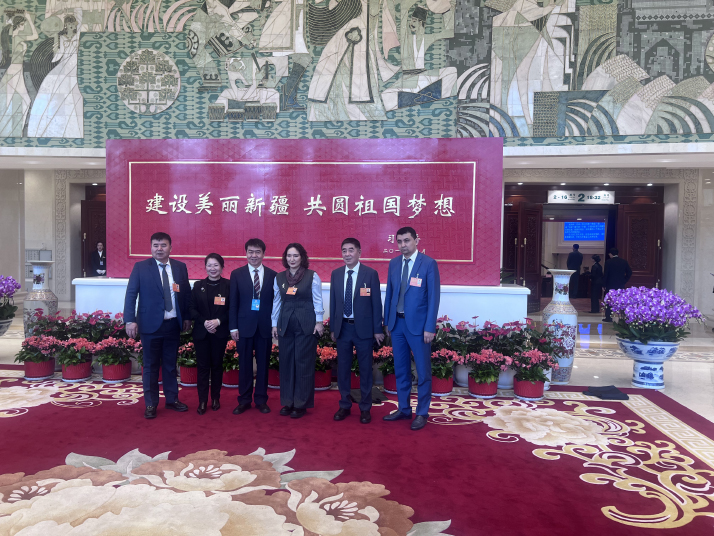 Overseas Chinese representatives who sat in on this year's session of the CPPCC Xinjiang Uygur Autonomous Regional Committee pose for a photo in Urumqi on January 30 (MA XIAOWEN)
People's congresses and Chinese People's Political Consultative Conference (CPPCC) committees at national and local levels make up a substantial—and distinctive—part of China's system of governance. At their annual full sessions, collectively known as the Two Sessions, deputies to people's congresses make legally binding decisions on major issues, while CPPCC committee members provide consultative input on policy and societal concerns. The Fourth Session of the 14th Xinjiang Uygur Autonomous Regional People's Congress and the Fourth Session of the 13th CPPCC Xinjiang Uygur Autonomous Regional Committee took place in Urumqi on January 26-30 and January 27-31, respectively, attracting a strong contingent of overseas journalists and international observers. Since 2024, foreign diplomatic envoys, representatives from international organizations and foreign-funded enterprises, overseas Chinese and individuals from China's Hong Kong and Macao special administrative regions have been invited to sit in on Xinjiang's Two Sessions. International media outlets have also been welcomed to cover the events from then on. Reporting on Xinjiang Kim Eun-jung, Beijing correspondent of Republic of Korea (ROK) newspaper Korea Economic Daily, shared her observations with Xinjiang Today after attending one of the press conferences held during the Two Sessions. She said she had requested to cover Xinjiang's Two Sessions with the aim of exploring the plans and measures the regional government is undertaking to accelerate the region's growth. With over a decade of journalism experience, Kim's attendance at this year's Two Sessions was her first trip to Xinjiang. She said gaining a close-up view of the region's development blueprint, and seeing the progress that has already been made gave her a better understanding of the process of development in the region, its future direction and the strong drivers pushing it forward. Kim was impressed by how Xinjiang is accelerating its transition from a traditional industrial structure to one centered on hi-tech industries. The region is proactively attracting foreign enterprises and integrating cutting-edge technologies such as AI and drones into its existing industries to boost productivity and efficiency, she added. She also noted Xinjiang's firm commitment to further strengthening its rail, road and logistics links with Central Asia and Europe. These efforts are designed to cut transportation costs and improve market accessibility, with neighboring countries also set to gain similar competitive edges from the enhanced connectivity. Kim said she believes increased exchange and business cooperation between her country and Xinjiang will help ROK enterprises boost their export competitiveness and shorten transportation times. To achieve this goal, she suggested both sides work toward the establishment of multiple cooperation platforms that will provide institutional guarantees for participation by ROK enterprises while pursuing mutual benefit. By building mutual trust and mitigating local operational risks, a range of cooperation measures can be formulated to provide benefit to both ROK enterprises and Xinjiang, she stressed. Mauro Ramos Pintos, China correspondent of Brazilian newspaper Brasil de Fato, covered Xinjiang's Two Sessions for the first time, with a particular focus on the region's rural revitalization initiatives. His visit to a goji berry farm in Xinjiang last year gave him a direct understanding of the region's rural development. He told Xinjiang's news portal Tianshan.net that he hoped to gather firsthand and authentic information at the Two Sessions and present the real Xinjiang to Brazilian audiences. He also looked forward to interviewing regional people's congress deputies in related fields to gain an in-depth understanding of Xinjiang's plans and practices in rural revitalization and ecological governance. "It is a highly significant experience for me, especially as audiences in South America are increasingly interested in China's political system," he said. "Therefore, a key focus of our coverage in China is socialism with Chinese characteristics for a new era, and it is crucial to understand the roles of CPPCC committees and people's congresses at different levels." Exploring Xinjiang's opportunities Jan-Jacob Alblas, General Manager of Dutch company Alblas International Transport b.v., which has a subsidiary in Xinjiang, told Tianshan.net that he has been making regular trips to Xinjiang to oversee his company's operations here since 2009. "It's my first time attending this event, and it's fascinating to learn more about China's political system and its institutional arrangements," he said. "Xinjiang occupies a strategic position as a bridge between the East and the West. I am particularly interested in the region's international development prospects and how our logistics company can better serve the market here in the future. Based in Europe, our company has a long history in international logistics. Xinjiang is a vital hub for Silk Road transportation links connecting China and Europe, and I have witnessed the region becoming increasingly open to international development and trade in recent years—this presents excellent future opportunities." Altinay Yeszhanova, Manager of the Development Department at Kazakhstan's Maxim Co. Ltd., told Tianshan.net that during the Two Sessions, she participated in a meaningful high-level event focused on deepening China-Kazakhstan cooperation. She said she is inspired by China's remarkable development journey, and hopes Kazakhstan can continue to thrive and grow as China has. On January 30, five overseas Chinese representatives shared their insights with media in Urumqi, after sitting in on the session of the CPPCC Xinjiang Autonomous Regional Committee. They spoke highly of Xinjiang's rapid economic development, expressing great hopes for greater cooperation with the region. "The government work report emphasized that Xinjiang has firmly integrated itself into cooperation under the Belt and Road Initiative (BRI), and enterprises have felt the tangible benefits of this integration deeply. The streamlined 'same-day entry and exit' customs clearance service at ports in Kashi (Kashgar), Tacheng and other places has significantly accelerated cargo turnover efficiency," said Manat Ibrayim, Deputy Director of the Kyrgyzstan Overseas Chinese Service Center and Chairman of MNT Investment Co. Ltd. The BRI, proposed by China in 2013, aims to boost connectivity along and beyond the ancient Silk Road routes. As Xinjiang has become more open, Manat's company has achieved steady business growth and expanded trade in Kashi. He called for broader project cooperation between China and Kyrgyzstan. With the in-depth advancement of Belt and Road cooperation, more and more Chinese-funded enterprises are going global. He said he will play a greater role in providing consulting services and support for overseas Chinese-funded enterprises. Tao Ling, Vice President of the Tajikistan Overseas Chinese Federation and General Manager of Dushanbe China Taste Co. Ltd., said, "This visit is full of pleasant surprises. From world-class ski resorts to visiting New Cicon Pharmaceutical Co. Ltd. and TBEA Co. Ltd., I saw that Xinjiang's industries have fully aligned with international standards." With long-term experience in trade in Tajikistan, Tao has a clear understanding of the local market's demand for high-quality enterprises and products from Xinjiang. He suggested establishing a special mechanism between Xinjiang and Tajikistan to provide targeted services for enterprises from both sides and support more Xinjiang enterprises in expanding their global footprint. Feng Zhipeng is chairman of Jingu Agricultural Complex Co. Ltd. in Tajikistan. He said he will share his experiences and observations in Xinjiang with people from all walks of life in Tajikistan, promote industrial matching between the two sides and contribute to bilateral cooperation in new energy, modern agriculture, cultural tourism and other fields. "I was the first to introduce Uygur medicine to the Uzbekistan market," said Usman Nigmat, Director of the Uzbekistan NDC-Medic Clinic and the Uzbekistan-China Trade Association. "Today, Uygur medicinal products such as zukamu granules (an analgesic) are available in 650 pharmacies across 12 regions of the country and have been widely recognized by local residents." As a director of the Uzbekistan-China Trade Association, Usman has promoted cooperation between Tashkent in Uzbekistan and a seedling base in Hutubi County, Changji Hui Autonomous Prefecture in Xinjiang. He said he will continue to act as a bridge between the two sides, inviting more Xinjiang enterprises, particularly pharmaceutical companies, to invest in Uzbekistan. Ilsharid Jumadil, General Manager of Kazakhstan's JLY DALA Service Co. Ltd., praised Xinjiang's achievements in smart agriculture and energy technology. She said she will introduce Xinjiang's mature agricultural and energy technologies and management experience to Kazakhstan and translate them into concrete cooperation projects. This will not only boost local development in Kazakhstan but also build a broader platform for Xinjiang enterprises to expand their international presence, she added. Comment to maxiaowen@cicgamericas.com |
|
||||||||||||||||||||||||||||
|